
By Mehul J Panchal, Founder, Filter Concept Group | 9-minute read | Pharmaceutical Filtration Series
In every sterile pharmaceutical manufacturing facility — from Hyderabad to Visp, from Singapore to Puerto Rico — the most critical utility is not electricity, not compressed air, not even clean steam. It is Water for Injection. WFI is the carrier for every parenteral formulation that leaves the plant. Its quality is governed by USP <1231>, Ph.Eur. 0169, the Indian Pharmacopoeia, the Japanese Pharmacopoeia, and the WHO TRS 970 Annex 2. A single OOS event on WFI conductivity, TOC, or endotoxin halts every sterile line in the plant simultaneously — with documented losses ranging from USD 6,000 to 25,000 per hour at a mid-size formulation site, and substantially more at large biologics manufacturing facilities.
What sits between the purified water loop and the WFI generation system is, almost universally, a Multi-Effect Distillation (MED) still or a Vapour Compression (VC) unit operating at 120 to 150°C. What protects that still from particulate damage is a single component: the still feed pre-filter. Get it right and the still runs validated batches for years on end. Get it wrong — or specify a generic cartridge housing without GMP-compliant geometry — and the next WHO PQ inspection or EU GMP Annex 1 audit identifies the gap as a Category II critical deficiency. This article explains why a properly engineered Hygienic Cartridge Filter Housing has become the global standard answer for WFI still feed protection, and why the cost of getting this wrong is measured in regulatory consequence rather than equipment cost.
The Hidden Stakes of WFI Still Feed Filtration
Three numbers explain why WFI still feed filtration deserves boardroom-level attention rather than a routine procurement decision.
Stake one: WFI generation downtime. When the MED still goes offline — for unplanned cleaning, evaporator tube descaling, or quality investigation — every sterile manufacturing line that depends on WFI stops. For a mid-size formulation plant, the documented loss is USD 6,000 to 25,000 per hour. For a large biologics or sterile fill-finish plant, it is multiples of that figure. A single 24-hour WFI outage caused by inadequate still feed filtration can cost USD 150,000 to 600,000 — against a properly specified Hygienic Cartridge Filter Housing that costs a fraction of one percent of that number.
Stake two: regulatory consequence. WHO PQ inspections, USFDA 21 CFR 211 audits, EU GMP Annex 1 inspections, and CDSCO Schedule M assessments all examine WFI system documentation. Inadequate still feed pre-filtration appears repeatedly as a Category II critical deficiency — the level above which a Form 483, EU GMP non-compliance statement, or WHO PQ suspension follows. The downstream consequence is loss of export licence, market access restriction, and — for plants supplying regulated markets — the kind of remediation cost that makes the original filtration investment look trivial.
Stake three: WFI quality OOS and batch impact. If resin bead fines from upstream EDI module failure pass through an inadequately specified pre-filter, they can appear in the WFI distribution loop and ultimately in finished sterile products. A foreign-material finding in a filled parenteral product is a critical batch event — typically USD 120,000 to 1,200,000 in batch loss, plus regulatory notification, plus the operational disruption of the investigation. The 5-micron pre-filter that would have caught those resin fines costs a fraction of one percent of one such event.
Why Generic Cartridge Housings Fail on WFI Still Feed Service
Pharmaceutical purified water service is not municipal water, not industrial process water, not even ultra-pure water for electronics. It is a regulated GMP utility with prescriptive design requirements that generic cartridge housings consistently fail to satisfy. Three failures recur across global pharmaceutical audits we have conducted:
- Non-pharmaceutical surface finish. Generic SS 316L cartridge housings are supplied with mill finish or shop polish at Ra 1.0–1.6 µm. ASME BPE — the global pharmaceutical bioprocess equipment standard — mandates Ra ≤ 0.5 µm for product-contact surfaces, with Ra ≤ 0.4 µm as the validated benchmark. Surface roughness above this threshold harbours biofilm, defeats CIP/SIP cycles, and shows up in audit reports as a documented gap.
- Dead legs and non-drainable geometry. Industrial cartridge housings are designed for service convenience, not for full drainability. Flow paths often retain stagnant water in valve manifolds, instrument tappings, and lid seal recesses — every one of which is a biofilm reservoir under GMP rules. ASME BPE design eliminates dead legs entirely; pharmaceutical-grade Hygienic Cartridge Housings are engineered around full drainability from day one.
- Industrial connections instead of sanitary tri-clamp. Threaded NPT or flanged ANSI connections create thread voids and gasket recesses incompatible with CIP cycles. Sanitary tri-clamp connections (per ASME BPE) provide consistent, validatable, fully cleanable joints — the only acceptable interface for product-contact pharmaceutical service.
Each of these failures is independently sufficient to fail a GMP audit. The compounding effect of all three together is what drives the recurring deficiency findings that haunt pharmaceutical operators relying on cost-driven generic filtration suppliers.
The FCPL Solution: Hygienic Cartridge Filter Housing for WFI Service
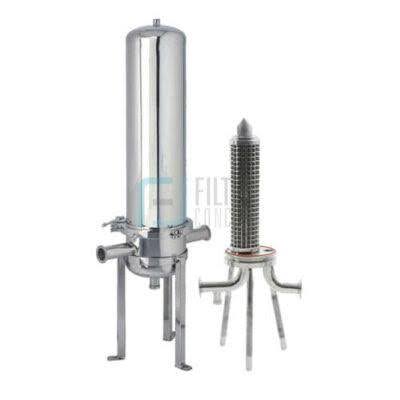
Filter Concept’s engineered solution for WFI still feed protection is a Hygienic Cartridge Filter Housing assembly installed on the purified water feed line, immediately upstream of the MED still feed pump. Every design element is matched to global GMP and ASME BPE requirements.
SS 316L hygienic geometry. Internal surface electropolished to Ra ≤ 0.4 µm — well below the ASME BPE threshold. Fully drainable design with no dead legs. Sanitary tri-clamp connections (1.5” to 3”) sized to the still feed flow demand. Lid closure with pharmaceutical- grade clamp and validated gasket material (typically EPDM or platinum-cured silicone, fully extractables-tested).
PP depth filter cartridge — 1 to 5 micron. Polypropylene depth filter media in the 1–5 micron range is the engineered pre-still standard — fine enough to capture resin bead fines from upstream EDI/MB-DI failures and scale particles from RO membrane cleaning cycles, coarse enough to give realistic element life on a properly maintained purified water system. FCPL provides extractables certification with each lot, supporting the qualification documentation file.
CIP / SIP compatible without disassembly. The housing tolerates CIP cycles with NaOH 2% and peracetic acid 0.5% in place. SIP cycles to 121°C are supported without seal degradation. The element changeout interval is governed by differential pressure indicator reading — not by elapsed time — which both extends element life and provides validatable trend data for the system review SOP.
GMP qualification documentation. Each housing ships with a documentation pack designed for direct insertion into the user’s validation file: material certificate to EN 10204-3.1, surface finish certificate, extractables study report, dimensional drawings, and DQ/IQ/OQ/PQ template documentation. This is the difference between buying a filter and buying a regulated pharmaceutical utility component.
FC-PDS™ specification methodology. Cartridge media grade and micron rating are specified from your actual purified water feed quality — measured TOC, conductivity, particulate count, residual chlorine — and your specific MED still capacity and feed flow. Generic specifications consistently under-perform on real pharmaceutical purified water systems; site-specific engineering does not.
Engineering Specifications at a Glance
| Parameter | Specification |
| Housing Material | SS 316L — internal surface Ra ≤ 0.4 µm (electropolished pharmaceutical grade) |
| Filter Media | Polypropylene depth filter cartridge — 1 to 5 micron |
| Connections | Sanitary tri-clamp 1.5” to 3” (ASME BPE compatible) |
| Internal Geometry | Fully drainable — zero dead legs (ASME BPE design rules) |
| Flow Rate | 500 to 5,000 LPH per housing |
| Operating Temperature | Up to 80°C (pre-still feed service); CIP cycle to 121°C |
| CIP / SIP Compatibility | Compatible — NaOH 2%, peracetic acid 0.5%, clean steam 121°C |
| Differential Pressure Indicator | Inline DP gauge for change-out trigger |
| Documentation Package | Material certificate (3.1), extractables report, surface finish certificate, dimensional drawings |
| Qualification Support | DQ / IQ / OQ / PQ documentation provided for validation file |
| Service Model | Sustainable Filters + FaaS (validated element supply with lot traceability) |
Operational and Compliance Outcomes
Pharmaceutical operators that install a properly specified Hygienic Cartridge Filter Housing on the WFI still feed line see returns concentrated in five distinct areas, each measurable against pre-installation baseline data and reportable to the QA leadership team:
- MED evaporator tube fouling reduced — still steam efficiency sustained, WFI output maintained at design rating, descaling frequency extended.
- WFI quality OOS events reduced to zero — resin bead and scale particulate breakthrough captured before reaching the still, eliminating the most common WFI quality failure mode.
- GMP audit findings on WFI system pre-filtration eliminated — the documentation pack and validated geometry directly address the most common Category II deficiency cited in WHO PQ, USFDA, and EU GMP Annex 1 inspections.
- Sterile production continuity protected — unplanned WFI generation downtime eliminated, sterile lines protected from cascade outage.
- ESG and sustainability reporting strengthened — Sustainable Filters service model provides documented filter media recovery for circular economy reporting alongside the regulatory qualification benefits.
For a mid-size sterile formulation plant, the combined value of avoided WFI downtime, eliminated quality OOS events, and audit findings closure typically exceeds USD 1 to 3 million annually — against a Hygienic Cartridge Filter Housing investment that recovers in well under one avoided WFI generation event. For large biologics manufacturers, the calculation scales linearly with sterile production capacity.
Global Standards & Regional Compliance Matrix
WFI generation pre-filtration sits at the intersection of pharmacopoeial water quality requirements, GMP equipment design rules, and pressure equipment safety. The FCPL Hygienic Cartridge Filter Housing is engineered to international baselines with regional certifications added per destination market:
| Region / Cluster | Applicable Standards & Regulations |
| International (Universal) | USP <1231> Water for Pharmaceutical Purposes · Ph.Eur. 0169 (Water for Injection) · ICH Q7 (GMP for APIs) · ASME BPE (Bioprocessing Equipment) · ISO 14644 (Cleanrooms) · PIC/S GMP |
| North America | USFDA 21 CFR 211 (cGMP for Finished Pharmaceuticals) · USP <1231> · USFDA Sterile Drug Products Guidance · ASME BPE-2022 · USP <645> Water Conductivity |
| Region / Cluster | Applicable Standards & Regulations |
| Europe | EU GMP Annex 1 (Manufacture of Sterile Medicinal Products, 2022 revision) · EU GMP Chapter 3 · Ph.Eur. 0169 · EMA Q&A on Water for Injection · PED 2014/68/EU |
| Middle East & GCC | Saudi FDA (SFDA) GMP · UAE Ministry of Health · Qatar Pharmaceutical Authority · GHC Pharmacopoeia · WHO TRS 970 Annex 2 |
| Africa | South Africa SAHPRA · Nigeria NAFDAC GMP · Egypt EDA · WHO PQ scheme requirements (Africa supply) |
| Asia-Pacific & India | CDSCO Schedule M (revised) · Indian Pharmacopoeia (IP) · WHO TRS 970 Annex 2 · Japan PMDA / JP · Korea MFDS · China NMPA / ChP · PIC/S members across APAC |
| Latin America | Brazil ANVISA RDC 658/2022 · Mexico COFEPRIS · Argentina ANMAT · Colombia INVIMA |
Two standards deserve particular attention. ASME BPE has emerged as the de facto global benchmark for pharmaceutical bioprocess equipment design — referenced even in jurisdictions where it has no statutory force, because it codifies the practical engineering of GMP-compliant geometry. EU GMP Annex 1 (2022 revision) has tightened sterile manufacturing utility documentation requirements significantly; pre-filter validation gaps now appear as the most common Annex 1 finding in EU and WHO PQ inspections of Indian, Chinese, and Latin American pharmaceutical manufacturers exporting to regulated markets.
The Bottom Line for QA Heads, Plant Heads, and Validation Teams
WFI still feed pre-filtration is the rare engineering decision where the regulatory case alone justifies the investment, before any of the operational benefits are counted. The cost of getting it wrong is not a maintenance line item — it is GMP audit outcome, export market access, and sterile production continuity. The cost of getting it right is a fraction of any one of those exposures.
Filter Concept has been engineering pharmaceutical filtration solutions for the global sector for over twenty-three years, with installations across formulation, API, biologics, and sterile fill- finish plants in 90+ countries. Customers include WHO PQ-listed manufacturers, EU MA- holders, USFDA-registered facilities, and global biopharmaceutical operators across India, GCC, Southeast Asia, Africa, and Latin America. The Hygienic Cartridge Filter Housing for WFI service is one of our most engineered, most validated, and most repeated installations — because pharmacopoeial requirements are universal, but the discipline of engineering ASME BPE-compliant geometry with validation-grade documentation is rare in the global filtration market.
If your last WHO PQ, USFDA, EU GMP, or CDSCO inspection raised any flags on WFI system documentation, if your MED still descaling frequency has crept upward over the last operating cycle, or if your validation team has identified a pre-filter qualification gap — your WFI still feed pre-filter is the first place to look. We are happy to review your purified water quality data and offer a specification at no obligation, anywhere in the world.
TALK TO OUR PHARMACEUTICAL FILTRATION TEAM
Send us your purified water quality data (TOC, conductivity, particulate count, residual chlorine), MED still capacity, and current pre-filter specification. We will return a sized FC-PDS™ specification, ASME BPE-compliant housing P&ID, and a validation documentation pack — within 5 working days. Service available across 90+ countries.
ABOUT THE AUTHOR
Mehul J Panchal is the Founder of Filter Concept Group, a global industrial filtration manufacturer serving 5,000+ customers across 90+ countries with 23+ years of engineering depth. The company’s product portfolio spans 50+ industries including oil & gas, LNG, petrochemicals, power, water treatment, pharmaceuticals, and food processing. Mehul writes on filtration economics, process engineering, and the practical realities of running filtration systems at industrial scale.