
By Mehul J Panchal, Founder, Filter Concept Group | 9-minute read | Oil & Gas Filtration Series
For the better part of three decades, refinery effluent treatment was treated as a compliance overhead — a cost centre, a maintenance line item, and an item that featured on a plant manager’s agenda only when an inspection notice arrived. That era is closing rapidly. From the European Union’s revised Industrial Emissions Directive to India’s NGT zero- liquid-discharge mandates, from California’s tightening NPDES permits to Saudi Aramco’s SAES-A-102 internal standards, the regulatory direction is unambiguous: refineries that cannot demonstrate consistent, documented, low-suspended-solids and low-oil discharge will lose operating licences, ESG ratings, and access to international finance.
What sits between a refinery’s primary effluent treatment plant and that compliance reality is, in almost every case, a polishing filtration stage. Get it right and the plant’s last line of defence holds against any inspection, any audit, and any tightening regulatory threshold. Get it wrong
— or worse, fit it as an afterthought with undersized housings and generic bag media — and the entire operating envelope of the refinery becomes vulnerable to a single regulatory excursion. This article explains why a properly specified Bag Filter Housing is the engineered standard answer for refinery effluent polishing, and why ZLD compliance has now moved from environmental department concern to boardroom risk register.
The New Reality: ETP Compliance Is No Longer Optional
Three forces have converged in the last five years to push refinery effluent treatment from background utility to boardroom-level risk.
Force one: tightening discharge thresholds. MoEFCC IS:2490 in India now mandates Class A discharge with TSS below 30 mg/L for refinery effluent, and most state PCBs are progressively pulling that down to 10 mg/L. The European Union’s BAT Reference for Refineries sets oil-in-water at less than 5 mg/L for surface discharge. Saudi Aramco’s SAES-A- 102 internal specification is stricter still. The U.S. EPA’s NPDES permits in environmentally sensitive watersheds (San Francisco Bay, Chesapeake) have moved to single-digit TSS limits. None of this is a temporary tightening — it is a structural shift.
Force two: zero-liquid-discharge (ZLD) mandates. India’s NGT has progressively expanded ZLD obligations to refineries in water-stressed zones. Singapore’s PUB has moved to ZLD as the default expectation for new refinery permits. China’s GB 31570 standard mandates ZLD for refineries in the Yangtze River basin. ZLD is no longer a Greenfield design feature — it is a retrofit obligation for operating refineries, and the polishing filtration stage is the gating equipment that determines whether ZLD is feasible.
Force three: ESG-linked finance. Refinery operators raising capital today face investor and lender questions about discharge quality, water reuse percentage, and documented compliance audit trails. ESG ratings from MSCI, Sustainalytics, and ISS-Oekom incorporate effluent compliance as a quantitative input. A documented TSS-and-oil discharge profile that consistently sits well below regulatory limits is now an ESG-rating asset. A profile that hovers near limits with periodic excursions is an ESG-rating liability.
Combined, these three forces have moved the cost of effluent compliance failure from “regulatory fine” into territory that includes operating license suspension, finance cost increase, and — in extreme cases — stranded asset risk. Against this backdrop, the cost of properly engineered polishing filtration is trivial. Yet most refineries we audit globally have under-specified or aged effluent polishing systems that no longer match the compliance reality their operators are working under.
Why Generic Bag Filtration Fails on Refinery ETP Service
Refinery effluent is not municipal wastewater, not boiler blowdown, and not cooling tower drainage. It is a chemically variable, contamination-mixed stream carrying residual oil from API separators, biological floc carryover from biological treatment, scale particles from cooling water blowdown, and — critically — trace organics that do not appear in any single laboratory test but accumulate over time. Three failures recur across global refinery audits we have conducted:
- Single-purpose media on a multi-purpose problem. A standard polyester felt bag at 25 micron will capture solids reasonably well but does almost nothing to reduce oil- in-water. Operators add an oil-water separator upstream and assume the bag handles solids. They are technically correct, and operationally wrong: residual oil after the API separator (typically 20–40 mg/L) bleeds through felt bags untreated. Compliance margins erode quietly until an inspection event exposes the gap. The engineered answer is FCPL’s Oil Adsorbing Bag Media — a single-pass solution that captures both TSS and oil simultaneously.
- Undersized housing capacity. Refinery effluent flows are highly variable — normal operation, plant upset, monsoon stormwater integration, turnaround flush. A housing sized for normal flow becomes a bottleneck during peak loading. Multi-bag configurations (8, 16, 24, 32 bag) provide the operational headroom required for real- world refinery effluent service, where peak flows can be 2–3× normal.
- Wrong material of construction. Refinery effluent pH varies between 5 and 9 depending on upstream operations. Trace chlorides from cooling water and trace amines from gas treating units make plain carbon steel housings susceptible to chloride pitting and amine corrosion. SS 316L is the engineered standard. For acidic effluent streams — spent caustic dilution, sulphuric acid alkylation drainage — polypropylene housings outperform stainless because of acid resistance.
Each of these failures is independently correctable. The compounding effect of all three together is what produces the “marginal compliance” profile that haunts so many global refineries today — always close to limits, never confidently below them, always vulnerable to the next inspection.
The FCPL Solution: Bag Filter Housing for Refinery ETP Polishing
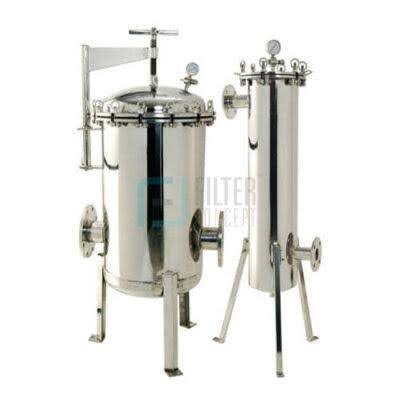
Filter Concept’s engineered solution for refinery effluent polishing is a Bag Filter Housing assembly installed as the final polishing stage — downstream of the API separator, dissolved- air-flotation unit, biological treatment, and any tertiary clarifier, but upstream of the discharge sump or the ZLD pre-treatment train.
Multi-bag configuration. Single, 4-bag, 8-bag, 16-bag, 24-bag, or 32-bag housings sized to the refinery’s actual peak effluent flow — up to 5,000 ms/day. Multi-bag designs offer the operational flexibility to isolate individual bags for changeout while the rest of the housing carries flow, eliminating the choice between bag fouling and process interruption.
Choice of media engineered to the contaminant profile. Polyester or polypropylene felt bags at 5–25 micron for TSS-dominant streams. FCPL Oil Adsorbing Bag Media — a proprietary fibre matrix that captures dispersed oil down to less than 5 mg/L while simultaneously polishing TSS to less than 10 mg/L — for combined TSS-and-oil streams. This single-pass capability is the technical differentiator that allows FCPL to outperform two-stage solutions from competitors.
Housing materials matched to chemistry. SS 316L for general refinery effluent service. Polypropylene for highly acidic streams. Optional EN 10204-3.1/3.2 material certification for European jurisdictions. Quick-release davit lid for rapid bag changeout under PPE-protected conditions — critical when ETP operators are managing changeout against an active discharge timing window.
Sustainable Filters service model. FCPL collects used filter bags from FaaS customers, recovers usable media, and returns recycled bag inventory to subsequent service cycles. This is one of the few filtration service models in the global market that produces a documentable circular-economy data point — directly supporting refinery ESG reporting and Scope 3 emissions calculations.
FC-PDS™ specification methodology. Bag micron rating, media type, and housing configuration are not selected from a catalogue. They are specified from your actual ETP outlet quality — measured TSS, oil-in-water, peak flow, average flow, pH range, temperature range, and the regulatory compliance threshold of your discharge permit. Site-specific engineering produces the compliance margin that audit-grade refinery operations now require.
Engineering Specifications at a Glance
| Parameter | Specification |
| Housing Material | SS 316L (corrosion-resistant) or Polypropylene (acid effluent service) |
| Filter Media (Standard) | Polyester / Polypropylene Felt Bags — 5–25 micron |
| Filter Media (Oil Service) | FCPL Oil Adsorbing Bag Media — simultaneous TSS + Oil capture |
| Configuration | Single, multi-bag (4, 8, 16, 24, 32 bag) housings |
| Flow Rate | 100–5,000 ms/day |
| Operating Pressure | Up to 10 bar |
| Operating Temperature | Ambient — 80°C continuous service |
| Parameter | Specification |
| TSS Outlet (Felt Bag) | Less than 10 mg/L (Class A discharge compliant) |
| Oil Outlet (Oil Adsorbing Bag) | Less than 5 mg/L in single pass |
| Pressure Vessel Code | ASME Section VIII Div. 1 / PED 2014/68/EU compatible |
| Closure Type | Quick-release davit lid for rapid bag changeout |
| Service Model | FaaS + Sustainable Filters (recycled bag media for ESG reporting) |
Operational and Commercial Outcomes
Refineries that install a properly specified Bag Filter Housing as their effluent polishing stage see returns concentrated in four areas, all measurable and reportable to the refinery management team:
- TSS outlet consistently below 10 mg/L and oil outlet below 5 mg/L — well within Class A discharge thresholds and EU BAT references, providing audit-grade compliance margin.
- Regulatory excursion frequency reduced to zero — eliminating the 10–100 lakh range of cumulative annual fines, show-cause notices, and consent renewal complications that under-specified ETP polishing typically incurs.
- ESG reporting strengthened — documented effluent quality data feeds directly into MSCI/Sustainalytics ESG submissions and supports access to sustainability-linked finance at improved rates.
- ZLD pre-treatment quality assured — reverse-osmosis ZLD trains downstream of the polishing stage operate at design recovery rates rather than being constrained by upstream solids and oil loading.
- Sustainable Filters circular economy reporting — used bag recovery and recycling produces a documentable Scope 3 emissions credit and a circular- economy data point for sustainability reports.
For a typical 5–10 MMTPA refinery, the combined value of regulatory protection, ESG-rating support, and ZLD train protection runs into millions of USD annually — against a Bag Filter Housing investment that recovers in well under nine months. Across FCPL’s global installed base, the most consistent feedback is not about cost savings but about the disappearance of compliance anxiety — the ETP manager who used to dread inspection now welcomes it.
Global Standards & Regional Compliance Matrix
Refinery effluent polishing sits at the intersection of environmental discharge permitting, pressure equipment safety, and increasingly, ESG-linked finance disclosure. The FCPL Bag Filter Housing for ETP polishing service is engineered to international baselines with regional certifications added per destination market:
| Region / Cluster | Applicable Standards & Regulations |
| International (Universal) | ISO 14001 environmental management · ISO 50001 energy management · GRI Standards (sustainability reporting) · World Bank Group EHS Guidelines for Petroleum Refining · IFC Performance Standard 3 (Resource Efficiency) |
| North America | EPA NPDES discharge permits · EPA Clean Water Act · EPA Subpart QQ (refinery wastewater) · OSHA PSM · Texas TCEQ permits · California State Water Board |
| Europe | EU Industrial Emissions Directive (IED) · BAT Reference (BREF) for Refineries · EU Water Framework Directive · PED 2014/68/EU · Reach Regulation · OSPAR PARCOM 2007/2 |
| Middle East & GCC | Saudi Aramco SAES-A-102 (Industrial Wastewater) · SAES- A-104 · ADNOC HSE specifications · KOC environmental standards · Qatar General Cleanliness Code · KSA PME regulations |
| Africa | NESREA effluent standards (Nigeria) · SABS South African National Standard · NEMA Kenya · DEFF South Africa NEMA · ANP Angola environmental |
| Asia-Pacific & India | MoEFCC IS:2490 (industrial effluent discharge) · CPCB Class A discharge standards · NGT ZLD orders · OISD-109 · BIS effluent quality standards · Singapore PUB · China GB 31570 (refinery effluent) |
| Latin America | Brazil CONAMA 430/2011 · ANP environmental compliance · Pemex environmental standards · SERNAGEOMIN Chile |
Two standards deserve particular attention from refinery management teams. First, the EU BAT Reference for Refineries (BREF) is increasingly being used as the de facto global benchmark, even in jurisdictions where it has no statutory force — international banks and insurers reference BREF when assessing refinery sustainability risk. Second, Saudi Aramco SAES-A-102 has become the unofficial GCC standard, with ADNOC, KOC, and QatarEnergy specifications converging on similar numbers. FCPL’s Bag Filter Housing for ETP service is engineered to satisfy both — making it specification-grade across the major refinery procurement environments worldwide.
The Bottom Line for Refinery Management Teams and ETP Engineers
Refinery effluent polishing is the rare engineering decision where the regulatory case, the commercial case, the ESG case, and the operational case all point in the same direction. The cost of getting it wrong is no longer a periodic fine — it is operating license risk, finance cost risk, and reputational risk on top of the underlying compliance exposure. The cost of getting it right is a fraction of the routine maintenance budget. The arithmetic is no longer debatable; only the timing of the upgrade is.
Filter Concept has been engineering effluent polishing solutions for the global refining and petrochemical sector for over twenty-three years, with installations across major refining clusters in 90+ countries. Customers include national oil companies, international majors, and EPC contractors building greenfield refining capacity from the U.S. Gulf Coast to Saudi Aramco SATORP, ADNOC Ruwais, IOCL Paradip, and Reliance Jamnagar. The Bag Filter Housing for ETP polishing service is one of our most engineered, most repeated installations
— because environmental compliance is universal, but the discipline of engineering a polishing stage that produces audit-grade margin (rather than marginal compliance) is rare in the global filtration market.
If your last regulatory inspection raised any flags on TSS or oil-in-water, if your ESG team has asked questions about effluent reporting, or if your ZLD project economics depend on upstream polishing performance — your effluent polishing filtration is the first place to look. We are happy to review your ETP outlet quality data and offer a specification at no obligation, anywhere in the world.
TALK TO OUR ETP FILTRATION TEAM
Send us your ETP outlet quality data (TSS mg/L, oil-in-water mg/L, average and peak flow, pH range) and your discharge permit thresholds. We will return a sized FC- PDS™ specification, a multi-bag housing P&ID schematic, and an indicative annual filtration cost — within 5 working days. Service available across 90+ countries.
ABOUT THE AUTHOR
Mehul J Panchal is the Founder of Filter Concept Group, a global industrial filtration manufacturer serving 5,000+ customers across 90+ countries with 23+ years of engineering depth. The company’s product portfolio spans 50+ industries including oil & gas, LNG, petrochemicals, power, water treatment, pharmaceuticals, and food processing. Mehul writes on filtration economics, process engineering, and the practical realities of running filtration systems at industrial scale.