

By Mehul J Panchal, Founder, Filter Concept Group | 8-minute read | Oil & Gas Filtration Series
Every refinery on earth shares the same first ten minutes of operation: crude oil arrives
— from a pipeline, a ship unloading arm, or a rail gantry — enters the battery limit, hits the crude transfer header, and starts its journey through the heat exchanger pre-heat train toward the desalter and the atmospheric distillation column. What happens in those ten minutes determines weeks of downstream operational quality. And what happens in those ten minutes is shaped, almost entirely, by what sits at the very front of the line: the crude inlet basket strainer.
Most refineries have one. Almost none of the refineries we audit have one that is correctly engineered for what is actually arriving in their crude. Pipeline scale. Weld slag from upstream pipeline repairs. Rust from storage tanks. Rubber expansion joint fragments. Wax agglomerates in heavy crude. Even, occasionally, larger debris that should not have entered the system but did. All of this hits the crude pre-heat train at one to two metres per second, and over a single operating cycle, fouls heat exchanger tube bundles to the point where pre-heat efficiency drops 5 to 15 percent and unscheduled exchanger isolation becomes routine. This article explains why a properly engineered Duplex Basket Filter Strainer at the crude transfer battery limit is the engineered global answer for this problem, and why it is one of the cheapest single retrofits a refinery operations team can sanction.
The Hidden Cost of Crude Pre-Heat Train Fouling
The economics of crude inlet protection rest on three numbers that most BD presentations bury too deep in the deck.
Number one: heat exchanger bundle cleaning cost. An exchanger isolation event for cleaning costs USD 50,000 to 150,000 per occurrence, requires 2 to 3 days of exchanger downtime, and forces a process workaround that limits crude throughput. Major Indian refineries (IOCL Panipat, BPCL Kochi) report average crude pre-heat exchanger cleaning frequencies of 2 to 4 times per year directly attributable to upstream debris ingress. Across a five-bundle pre-heat train, that is 10 to 20 cleaning events per year per train — USD 500,000 to 3 million in annual maintenance line items, before the production impact is counted.
Number two: pre-heat efficiency loss. Each fouled exchanger drops pre-heat efficiency by 5 to 15 percent. The downstream consequence is a colder feed to the atmospheric column furnace, which now has to deliver more duty to maintain feed temperature. Furnace fuel gas consumption rises. Furnace tube heat flux rises. Furnace decoking frequency increases. The compounding cost across a 10 MMTPA refinery is in the USD 1 to 3 million per year range — a number that does not appear in any single line item but bleeds through the refinery’s entire energy balance.
Number three: CDU throughput at risk. When pre-heat train degradation is severe, the only operational lever is to reduce CDU throughput — a 10 MMTPA refinery operating at 90 percent throughput for two weeks loses USD 5 to 8 million in product margin. Saudi Aramco and ADNOC refinery specifications explicitly require crude inlet strainers as mandatory equipment items — because the cost of getting this wrong scales catastrophically against the trivial cost of getting it right.
Why Generic Strainers Fail on Crude Inlet Service
Crude inlet protection is one of those rare engineering problems that looks simple from the procurement team’s desk and turns out to be unforgiving in practice. Three failure modes recur across global refinery audits:
- Single-basket configurations on a 24/7 process. A single-basket strainer requires process shutdown for basket cleaning. Refineries with a crude surge tank can manage this; most refineries cannot. The result is operators running with a fouled
basket past changeout point, accepting elevated pressure drop and debris bypass risk because the alternative is worse. The engineered answer is a Duplex configuration with two baskets in parallel — cleaning happens on the offline basket while the online basket carries full flow. Zero process interruption.
- Wrong basket aperture for the actual debris. Generic strainers ship with 1–2 mm screens that look conservative on paper and prove inadequate in service. Crude inlet debris includes 3–5 mm wax agglomerates, weld slag fragments, and pipeline scale flakes that need to be captured before the heat exchanger train, not after. The engineered answer is a 3–5 mm perforated plate basket sized to the actual debris profile, with FC-PDS™ documenting the basket open area and pressure drop curve.
- No magnetic capture for ferrous debris. Pipeline scale, weld slag, and tank rust are predominantly ferromagnetic. A perforated basket without an integral magnetic bar captures these on dimensional contact only — small ferrous fragments slip through and end up embedded in heat exchanger tube ends, driving accelerated corrosion. The engineered answer is an integral magnet bar within the basket assembly, capturing fine ferrous debris that would otherwise penetrate the protection envelope.
Each of these failures is independently correctable. The compounding effect of all three together is what produces the recurring exchanger cleaning frequency that haunts refinery maintenance budgets at most facilities globally.
The FCPL Solution: Duplex Basket Filter Strainer with Integral Magnet Bar
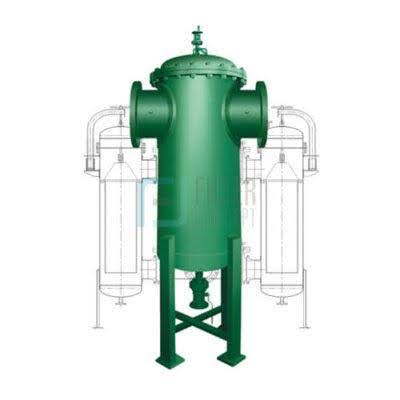
Filter Concept’s engineered solution for crude transfer line service is a Duplex Basket Filter Strainer assembly installed at the refinery battery limit, immediately upstream of the crude pre- heat exchanger train and the desalter feed pump. The architecture is purposefully matched to the operational reality of refinery crude inlet service.
Duplex configuration with online switchover. Two basket housings in parallel with a flow- balanced changeover valve manifold. Basket cleaning happens on the offline housing while the online housing carries full crude flow at design pressure drop. Zero shutdown. Zero throughput compromise. This is the configuration that Saudi Aramco SAES-J-903 mandates for new refinery installations — and which most legacy refineries can retrofit during a routine pump maintenance window.
Forged CS A105 housing with SS 316L basket. Forged carbon steel A105 body provides the structural rating at refinery economic cost. The wetted basket is SS 316L for chloride and sour-service compatibility, with NACE MR0103 / ISO 17945 compliance documented for sour crude service. Pressure rating from ANSI 300# to 600# (ASME B16.5) covers the full range of refinery crude transfer pressures, with optional EN 10204-3.1/3.2 material certification for European jurisdictions.
Perforated plate basket with integral magnet bar. The basket is a perforated SS 316L plate with 3–5 mm openings sized to the actual debris profile of your crude source. Embedded within the basket assembly is an integral neodymium magnet bar that captures ferrous debris on the upstream face — pipeline scale, weld slag, tank rust — with zero pressure drop penalty. This is the technical differentiator that sets the FCPL Basket Filter apart from generic strainer products in the global market.
Sized to the crude profile. Light crude (API >35), medium crude, heavy crude (API <22), and bituminous crude all have different flow characteristics, viscosity profiles, and debris signatures. FC-PDS™ sizes the basket open area and pressure drop allowance from your actual crude assay, throughput, and inlet temperature. Generic specifications routinely under- perform on heavy crude duty; site-specific engineering does not.
Service interface. Quick-release bolted closure for rapid basket changeout under PPE- protected refinery operations. Companion provisions for pressure drop indicator, drain valve, and venting per refinery safety protocols. Optional pneumatic swing arm for heavy basket lifting where local handling regulations require it.
Engineering Specifications at a Glance
| Parameter | Specification |
| Housing Material | CS A105 forged body (refinery hydrocarbon service) or upgraded SS 316L |
| Basket Material | SS 316L perforated plate — 3 to 5 mm openings |
| Magnetic Bar (integral) | Embedded in basket for ferrous debris capture from pipeline scale |
| Pressure Class | ANSI 300# to 600# flanges (ASME B16.5) |
| Sizes | DN150 (6”) to DN500 (20”) for refinery crude transfer line service |
| Service | Light to heavy crude (API 8–60), inlet temperature up to 60°C |
| Configuration | Duplex arrangement standard — uninterrupted flow during basket cleaning |
| Pressure Drop (clean) | Less than 0.2 bar across full design flow |
| Pressure Vessel Code | ASME Section VIII Div. 1 / PED 2014/68/EU compatible |
| Hazardous Area Rating | ATEX Zone 1 / IECEx (refinery battery limit zone) |
| Hazardous Service Compliance | NACE MR0103 / ISO 17945 (sour crude service) |
| Parameter | Specification |
| Service Model | Retrofit + scheduled basket cleaning service |
Operational and Commercial Outcomes
Refineries that install a properly engineered Duplex Basket Filter Strainer at the crude transfer battery limit see returns concentrated across maintenance, energy, and throughput — typically within the first six months of operation:
- Crude pre-heat exchanger cleaning frequency reduced from 2–4 events per year to 0–1 event per year per train — saving USD 200,000 to 600,000 per year in cleaning costs and avoided exchanger isolation.
- Pre-heat efficiency sustained within 2–3% of clean-condition baseline — reducing furnace fuel gas consumption and deferring furnace decoking events.
- CDU throughput protected — elimination of unplanned throughput cuts driven by pre-heat train fouling, securing product margin against operational disruption.
- Desalter inlet quality improved — macro-debris removal upstream of the desalter prevents electrostatic field disruption and downstream chloride breakthrough.
- Aramco SAES-J-903 compliance demonstrable — critical for refineries qualifying as Aramco-grade suppliers or operating under Aramco licensing terms.
For a 10 MMTPA refinery, the combined annual return from cleaning frequency reduction, pre- heat efficiency sustained, and throughput protection typically falls in the USD 1 to 3 million range. The Basket Filter Strainer capital investment recovers in well under a single avoided pre-heat exchanger cleaning event. Across global refinery installations, this is one of the simplest, lowest-risk capital decisions on the maintenance manager’s desk — and yet it remains under-specified at most facilities.
Global Standards & Regional Compliance Matrix
Crude inlet protection sits at the intersection of three regulatory domains: pressure equipment safety, refinery sour service materials compliance, and hazardous area certification (because refinery battery limits are classified zones). The FCPL Basket Filter Strainer is engineered to international baselines with regional certifications added per destination market:
| Region / Cluster | Applicable Standards & Regulations |
| International (Universal) | API 592 (Filters for Petroleum) · ASME B16.5 (Pipe Flanges) · ASME Section VIII Div. 1 · NACE MR0103 / ISO 17945 (refinery sour service) · ATEX 2014/34/EU · IECEx Zone 1 |
| North America | ASME BPVC · API 614 · OSHA PSM 29 CFR 1910.119 · EPA NSPS Subpart Ja · NFPA 30 (flammable liquids |
| Region / Cluster | Applicable Standards & Regulations |
| handling) | |
| Europe | PED 2014/68/EU · EN 13445 · ATEX Directive 2014/34/EU · SEVESO III · EN 10204-3.1/3.2 material certification |
| Middle East & GCC | Saudi Aramco SAES-J-903 (filtration standard — mandatory crude inlet strainer) · ADNOC technical specifications · KNPC standards · QatarEnergy refining specs |
| Africa | NUPRC pipeline & refining regulations (Nigeria) · SABS (South Africa) · SONCAP · Sonangol Angola |
| Asia-Pacific & India | OISD-109 (Refinery Safety) · OISD-118 · PESO certification · IS 2825 · PETRONAS / PTT engineering specs (SE Asia) · PNGRB regulations (India) |
| Latin America | Petrobras N-2624 · Pemex NRF specifications · ANP (Brazil) · INMETRO compliance |
Saudi Aramco SAES-J-903 deserves specific mention. It explicitly mandates crude inlet basket strainers for all Aramco-licensed refineries, with prescriptive duplex configuration and material requirements. FCPL’s Basket Filter Strainer is engineered to satisfy SAES-J-903 in full — making us a qualifiable supplier across the Aramco supply chain and the broader GCC market that follows Aramco precedents.
The Bottom Line for Refinery Maintenance and Operations Teams
Crude inlet protection is the lowest-risk, fastest-payback capital decision in the refinery maintenance manager’s available portfolio. The cost of installation is recovered in a single avoided exchanger cleaning. The compounding savings across pre-heat efficiency, throughput protection, and downstream desalter performance are the bonus.
Filter Concept has been engineering crude inlet filtration solutions for the global refining sector for over twenty-three years, with installations across major refining clusters in 90+ countries. Customers include national oil companies, international majors, EPC contractors, and independent refiners from the U.S. Gulf Coast to Saudi Aramco refineries, ADNOC Ruwais, Reliance Jamnagar, IOCL Paradip, and Petronas Pengerang. The Basket Filter Strainer for crude transfer line service is one of our most repeated installations — because the chemistry of crude inlet debris is universal, and the discipline of engineering a duplex magnetic-bar configuration correctly is what separates genuine refinery filtration suppliers from generic strainer vendors.
If your crude pre-heat exchanger cleaning frequency exceeds twice per year per train, if your CDU furnace fuel consumption has crept upward over the last operating cycle, or if your
last refinery audit raised any flags on crude inlet protection — your battery limit basket strainer is the first place to look. We are happy to review your crude assay, throughput, and last 12 months of exchanger cleaning history, and offer a specification at no obligation, anywhere in the world.
TALK TO OUR REFINERY FILTRATION TEAM
Send us your crude assay (API gravity, sulphur, particulate profile),
CDU throughput, and last 12 months of pre-heat exchanger cleaning history.
We will return a sized FC-PDS™ specification, a duplex basket filter P&ID,
and an indicative annual savings calculation — within 5 working days.
Service available across 90+ countries.
ABOUT THE AUTHOR
Mehul J Panchal is the Founder of Filter Concept Group, a global industrial filtration manufacturer serving 5,000+ customers across 90+ countries with 23+ years of engineering depth. The company’s product portfolio spans 50+ industries including oil & gas, LNG, petrochemicals, power, water treatment, pharmaceuticals, and food processing. Mehul writes on filtration economics, process engineering, and the practical realities of running filtration systems at industrial scale.