

By Mehul J Panchal, Founder, Filter Concept Group | 9-minute read | Desalination Filtration Series
Seawater Reverse Osmosis is now the dominant desalination technology globally, accounting for over 65% of new installed capacity. From Jubail to Hassyan, from Chennai to Carlsbad, from Sydney to Las Palmas, SWRO plants supply the daily drinking water for hundreds of millions of people. The economics of every one of these plants rests on a single technical variable: the Silt Density Index of the water arriving at the high-pressure RO feed pump. SDI determines membrane fouling rate, membrane life, Specific Energy Consumption, plant availability, and ultimately the cost of every cubic metre of treated water leaving the plant.
What sits between the seawater intake screen and the RO train is the most engineering-intensive multi-stage pre-treatment in the entire water industry: dissolved-air flotation, dual-media filtration, ultrafiltration, cartridge filtration. What is missing in most plants — and what consistently distinguishes high-availability SWRO assets from chronically-troubled ones — is a self-cleaning disc filter at one or both of the engineering hinge points: between the dual-media filter and the UF skid, and during turbidity-spike or jellyfish-bloom events at the intake. This article explains why a properly engineered Self-Cleaning Disc Filter has become the de facto SWRO best-practice answer for these protection points, and why it is one of the highest-leverage retrofits available to a desalination plant operator today.
The Hidden Stakes of SWRO Pre-Treatment Failure
Three numbers explain why pre-treatment filtration deserves continuous engineering attention rather than being treated as a static utility installation.
Stake one: SDI excursions and membrane life. A single SDI excursion above 4 — caused by upstream UF breakthrough, jellyfish biopolymer release, or coagulation upset — reduces SWRO membrane life by 30 to 40 percent. RO membranes cost USD 1,000 to 1,800 per element; a major SWRO train carries 50 to 200 elements, with replacement values of USD 50,000 to 360,000 per train. Excursion-driven membrane life loss compounds rapidly across plant operating cycles — and the engineered solution is upstream stable filtration, not heroic membrane chemistry.
Stake two: UF membrane integrity events. UF hollow fibre membranes are vulnerable to macro-particle damage from fibres, algae clusters, jellyfish shreds, and DMF breakthrough during monsoon turbidity events. Even one particle event can rupture hollow fibres — with documented impact at major SWRO plants of USD 36,000 to 100,000 per emergency cleaning event, plus Rs 60,000–1,80,000 per damaged element where replacement is required. The Chennai SWRO plants and the GCC plants on the Arabian Sea coast experience seasonal jellyfish bloom events that can take a UF train offline within hours without proper upstream protection.
Stake three: plant availability and product water revenue. A UF train offline event at a 100 MLD SWRO plant shuts down product water output within two hours. For coastal cities relying on desalination as a lifeline supply during dry-season reservoir shortage — Chennai during southwest monsoon, GCC capitals throughout summer — the cost of plant unavailability is measured not in maintenance line items but in municipal water security. Desalination plant operating contracts increasingly include availability penalty clauses that turn pre-treatment performance into a direct revenue line item.
Why Conventional Filtration Cannot Solve SWRO Pre-Treatment
SWRO pre-treatment between the dual-media filter and the UF skid faces three constraints that defeat conventional cartridge or bag filtration approaches:
- Continuous 24/7 service. SWRO plants run continuously — disposable cartridges between DMF and UF are economically and operationally impossible at the flows involved (typically 500–5,000 ms/hr per train). The only viable architecture is a continuous self-cleaning system that runs without operator intervention or process interruption.
- Variable contamination loading. Seasonal events drive contamination loading well beyond design average. Arabian Sea monsoon turbidity reaches 50–200 NTU. Jellyfish bloom events release biopolymer gel that blocks UF in hours. Algal blooms produce extracellular organic matter that overwhelms coagulation. Conventional filtration sized to average loading fails on the days when filtration matters most.
- Backwash water budget. SWRO plants are increasingly water-conservative; pre-treatment systems consuming significant backwash flow conflict with overall plant water recovery targets. Self-cleaning disc filtration typically consumes less than 1 percent of filtered flow as cleaning water — meeting modern desalination water-conservation specifications without operational compromise.
Each of these constraints independently rules out the obvious filtration architectures. Solving them together requires a purpose-engineered self-cleaning disc filter — which is precisely the gap FCPL’s product is designed to fill.
The FCPL Solution: Self-Cleaning Disc Filter for SWRO Pre-Treatment
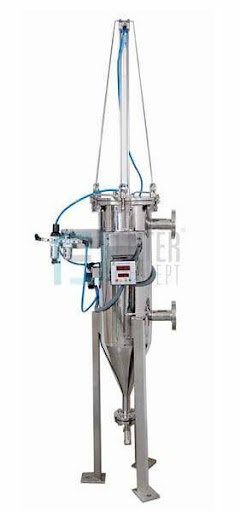
Filter Concept’s engineered solution for SWRO pre-treatment is a Self-Cleaning Disc Filter installed at one of two engineering hinge points: between the dual-media filter outlet and the UF feed manifold (the standard configuration), and / or upstream of coagulation injection during seasonal turbidity-spike or bloom events (the protection configuration).
Polypropylene disc stack at 100–200 micron. The grooved disc stack provides depth-style separation that captures biopolymer gel, jellyfish shreds, algae cell aggregates, and coarse DMF breakthrough particles — all of which would otherwise reach the UF train. Disc grooves are sized to the actual contamination spectrum at your intake, with FC-PDS™ documenting the disc grade and cleaning cycle from your seawater quality history.
FRP or SS 316L housing matched to chemistry. FRP body is the standard choice for chlorinated seawater pre-treatment service — immune to chloride pitting and economically attractive at SWRO scale. SS 316L is available where higher-temperature CIP cycles or specific tender requirements call for it. EPDM seals are fully compatible with chlorinated seawater (Cl₂ 0.5–2 mg/L) used in standard SWRO biofouling control.
Automated backwash on differential pressure. Backwash cycle triggers automatically on DP setpoint, typically every 15 to 20 minutes during normal operation and more frequently during bloom or turbidity-spike events. The backwash uses less than 1 percent of filtered flow
- a documented water-conservation advantage over conventional self-cleaning architectures. ATEX-rated actuators available for plants with hazardous-area integration requirements.
Sized to plant flow with N+1 redundancy. Single units handle 200 to 5,000 ms/hr; larger plants use multi-unit configurations with N+1 redundancy. FCPL sizes the unit count from the actual plant feed flow, expected peak loading, and downstream UF protection criterion. The result is a pre-treatment stage that protects the plant during the worst seasonal events, not just during average operation.
FaaS service model. Annual service includes disc element inspection, seal replacement, actuator servicing, and backwash cycle optimisation against actual seasonal water quality. The plant receives a documented preventive maintenance log that supports IDA Best Practice compliance, EPC warranty terms, and increasingly ESG-linked finance reporting.
Engineering Specifications at a Glance
| Parameter | Specification |
| Housing Material | FRP (Fibre-Reinforced Plastic) or SS 316L (seawater service) |
| Disc Material | Polypropylene disc stack — 100 to 200 micron grooves |
| Seal Material | EPDM — chlorinated seawater compatible (Cl₂ 0.5–2 mg/L) |
| Flow Rate | 200 to 5,000 ms/hr per disc filter train |
| Operating Pressure | Up to 6 bar |
| Backwash | Auto DP-triggered, 15–20 minute cycle, 24/7 continuous service rated |
| Backwash Water Consumption | Less than 1% of filtered flow (industry-leading efficiency) |
| Outlet SDI | Sustained reduction of 1–2 SDI units — protecting downstream UF and SDI<3 RO feed targets |
| Service | Pre-UF macro-debris and algae bloom protection |
| Hazardous Area Rating | ATEX-rated actuators where required |
| Pressure Vessel Code | ASME Section VIII Div. 1 / PED 2014/68/EU compatible |
| Service Model | Retrofit + FaaS (disc element replacement AMC) |
Operational and Commercial Outcomes
SWRO plants that install a properly specified Self-Cleaning Disc Filter at the DMF-UF interface see returns concentrated across membrane life, plant availability, and energy consumption — typically within the first season of operation:
- UF emergency cleaning events reduced from 4–6 per year to 0–1 per year — saving USD 36,000–80,000 per avoided event at a typical major SWRO plant.
- UF membrane life extended from 5 years to 7–8 years — deferring USD 60,000–3,600,000 in element replacement on large UF trains.
- RO membrane life sustained near design — SDI excursion frequency reduced, with documented 30–40 percent improvement in membrane operating life on plants where pre-treatment was the limiting factor.
- Plant availability protected to 92%+ — unplanned outages from turbidity spikes and bloom events eliminated, securing product water revenue.
- Specific Energy Consumption stabilised — RO feed quality consistency reduces feed-pressure spikes, with documented 2–4 percent SEC improvement on mature plants where pre-treatment had degraded.
For a 100 MLD SWRO plant, the combined annual return from membrane life extension, availability protection, and SEC improvement typically exceeds USD 1.5 to 4 million — against a Self-Cleaning Disc Filter retrofit investment that recovers in well under twelve months. Across FCPL’s desalination installed base in the GCC, India, and Southeast Asia, this is one of the most consistent paybacks documented.
Global Standards & Regional Compliance Matrix
SWRO pre-treatment filtration sits at the intersection of drinking water quality regulation, marine discharge permitting, and pressure equipment safety. The FCPL Self-Cleaning Disc Filter is engineered to international baselines with regional certifications added per destination market:
| Region / Cluster | Applicable Standards & Regulations |
| International (Universal) | WHO Guidelines for Drinking Water Quality (4th Ed.) · IDA Best Practices for SWRO · ASME Section VIII Div. 1 · NSF/ANSI 61 (potable water materials) · ISO 14001 |
| North America | EPA Safe Drinking Water Act · NSF/ANSI 61 · California Title 22 Recycled Water · ASME BPVC · USEPA Surface Water Treatment Rule |
| Europe | EU Drinking Water Directive (2020/2184) · PED 2014/68/EU · EN 12873 (drinking water materials) · OSPAR coastal discharge |
| Middle East & GCC | Saudi SASO 1052 · UAE.S 999 (drinking water standard) · |
| Region / Cluster | Applicable Standards & Regulations |
| GSO 149 · SWCC technical specifications · DEWA / ADWEA / KAHRAMAA standards · MEPA marine discharge limits | |
| Africa | SABS South African National Standard (drinking water) · NESREA Nigeria · KEBS Kenya |
| Asia-Pacific & India | BIS IS 10500 (drinking water) · BIS 14543 (desalinated water) · CPCB coastal water intake standards · PESO certification · IDAWEA guidelines · Singapore PUB |
| Latin America | Brazil ABNT NBR drinking water standards · ANP · Pemex / CFE specifications · SISS Chile |
Two frameworks deserve specific attention. The IDA Best Practices for SWRO has emerged as the de facto global engineering benchmark, referenced by EPCs and operators worldwide regardless of statutory jurisdiction. WHO Guidelines for Drinking Water Quality (4th Edition) sets the universal floor for product water that desalinated supply must meet — and pre-treatment filtration documentation is increasingly examined by international financiers underwriting desalination capacity. FCPL’s Self-Cleaning Disc Filter is engineered to satisfy both, and qualified for direct supply across SWCC, DEWA, ADWEA, KAHRAMAA, IDE, ACCIONA, SUEZ, and Veolia procurement environments.
The Bottom Line for Desalination Plant Operators and EPC Contractors
SWRO pre-treatment filtration is one of the rare engineering decisions in the desalination world where the membrane life case, the plant availability case, the energy consumption case, and the water security case all align in the same direction. The cost of getting it wrong cascades across every downstream component of the plant. The cost of getting it right is a fraction of any one of those exposures.
Filter Concept has been engineering desalination filtration solutions for the global SWRO sector for over twenty-three years, with installations across major desalination clusters in 90+ countries. Customers include national water utilities, EPC contractors, and operating partners across the GCC region (the world’s highest concentration of SWRO capacity), India’s coastal desalination programme, Southeast Asian island and remote-coast operations, and emerging markets in Africa and Latin America. The Self-Cleaning Disc Filter for SWRO pre-treatment is one of our most engineered, most repeated installations — because the chemistry and biology of seawater are universal, but the discipline of engineering pre-treatment that protects against worst-case seasonal events is what separates serious desalination filtration suppliers from generic strainer vendors.
If your last UF cleaning frequency exceeded design, if your RO membrane replacement is approaching schedule earlier than expected, or if your last seasonal bloom event drove unplanned plant unavailability — your DMF-UF pre-treatment filtration is the first place to look. We are happy to review your seawater intake quality history and offer a specification at no obligation, anywhere in the world.
TALK TO OUR DESALINATION FILTRATION TEAM
Send us your seawater intake quality data (turbidity range, SDI history, seasonal bloom history), plant capacity, and downstream UF/RO specification. We will return a sized FC-PDS™ specification, disc filter P&ID, and an indicative annual SDI/availability improvement projection — within 5 working days. Service available across 90+ countries.
ABOUT THE AUTHOR
Mehul J Panchal is the Founder of Filter Concept Group, a global industrial filtration manufacturer serving 5,000+ customers across 90+ countries with 23+ years of engineering depth. The company’s product portfolio spans 50+ industries including oil & gas, LNG, petrochemicals, power, water treatment, pharmaceuticals, and food processing. Mehul writes on filtration economics, process engineering, and the practical realities of running filtration systems at industrial scale.