

By Mehul J Panchal, Founder, Filter Concept Group | 9-minute read | Oil & Gas Filtration Series
Every Fluid Catalytic Cracking unit operating today — from Ras Tanura to Ruwais, from Vadinar to Vizag, from Cilacap to Cartagena — produces a stream that the refinery economics manager rarely thinks about and the FCC unit engineer thinks about constantly: slurry oil. It pulls off the bottom of the main fractionator at three to five percent of feed, carries the heaviest aromatic fractions, and — critically — carries whatever catalyst fines escaped the third-stage cyclones during the last regeneration cycle.
The economics of slurry oil hinge on one number: catalyst fines content in parts per million. Below 500 ppm, slurry oil is a premium feedstock for carbon black manufacture, needle coke production, or petrochemical co-processing — commanding a USD 15 to 25 per barrel premium over fuel oil pricing. Above 2,000 ppm, the same stream is a downgraded fuel oil that
no petrochemical buyer will accept. The difference between these two outcomes is not the FCC unit. It is what sits between the slurry settler outlet and the slurry oil rundown tank. This article explains why a sintered-metal Catalyst Recovery System has become the standard engineered answer for that gap, and why refineries that install it correctly typically see USD 2.5 to 4.5 million per year in pure revenue uplift on a 500 BPSD slurry stream.
The Slurry Oil Problem That Most Refineries Live With
FCC catalyst is engineered as zeolite/alumina spheres in the 60 to 80 micron range — deliberately sized to fluidise correctly and to be captured by the regenerator cyclones. The cyclones, however, are not perfect. Catalyst attrition during regeneration cycles produces fines below 20 micron that the cyclone system cannot capture efficiently. These fines exit through the main fractionator and concentrate in the slurry oil drawn from the bottom.
Three operational problems result, and each one is independently expensive.
Problem one: slurry pump erosion. Slurry circulation pumps, slurry product pumps, and slurry-to-bottoms exchanger feed pumps all run on contaminated slurry oil. Catalyst fines abrade impellers at rates that collapse mean time between repairs from a design 24 to 36 months down to 3 to 6 months. A single slurry pump rebuild typically costs USD 30,000 to 80,000 in parts, plus the operational disruption of switching to a standby pump and managing the maintenance window.
Problem two: slurry exchanger fouling. Slurry-to-feed exchangers and slurry-to-steam- generator exchangers foul on the slurry side as fines deposit and bake onto tube surfaces at 280 to 350°C operating temperature. Heat transfer coefficients drop progressively. Hydroclean intervals shorten. Refinery energy efficiency degrades quietly across the slurry train, with documented impacts of USD 500,000 to 1.5 million per year in lost heat recovery on large FCC units.
Problem three — and the largest commercially: slurry oil downgrade. Slurry oil with greater than 1,000 ppm catalyst fines is unsellable as petrochemical feedstock. Carbon black plants reject it because the fines coke their reactor furnaces. Needle coke producers reject it because the fines compromise the resulting coke crystal structure. The slurry then has to be sold as fuel oil at a discount of USD 15 to 25 per barrel, or co-processed in a delayed coker where the fines accelerate coke drum fouling and downstream fractionator pressure drop.
Across major refining clusters worldwide, hundreds of FCC units run with this revenue leak permanently embedded in their P&L. Most refinery economics managers do not see it as a leak; they see it as an unfortunate but unchangeable feature of FCC operation. It is, in fact, entirely changeable.
Why Conventional Filtration Cannot Solve This
Slurry oil filtration is the most demanding service in the entire refining filtration landscape. Three constraints make it impossible for conventional cartridges:
- Slurry oil exits the main fractionator at 280 to 350°C. Polypropylene cartridges melt below 80°C. Polyester and aramid composites top out at 200°C. Even glass-fibre coalescers struggle above 250°C continuous service. The only viable media is sintered stainless steel — metallic by construction, rated for continuous service to 350°C and short-duration backflush at 650°C.
- Solids loading. Inlet catalyst fines at 1,000 to 3,000 ppm in a high-viscosity hydrocarbon matrix overload any conventional disposable cartridge within The economics of disposable filtration on this service are non-existent — a 24-hour element life would consume a 20-cartridge skid every two weeks. The only viable answer is a backflushable element that can be cleaned in-situ during operation.
- Corrosion Slurry oil contains residual sulphur compounds, naphthenic acids, and trace HCl from desalter overhead. Standard carbon steel housings suffer from hydrogen-induced cracking (HIC) under cycling. The correct material is either HIC-resistant CS plate (NACE MR0103 compliant) or SS 316L — specified based on the actual slurry oil composition from the refinery’s own laboratory data.
These constraints together explain why generic refinery filtration suppliers do not address the FCC slurry circuit. Solving it requires purpose-engineered equipment that does not appear in standard product catalogues. That is precisely the gap FCPL’s Catalyst Recovery System is designed to fill.
The FCPL Catalyst Recovery System: How It Works
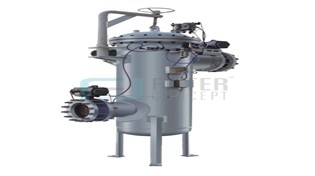
The FCPL Catalyst Recovery System is a high-temperature, high-pressure backflushable filtration assembly engineered specifically for the FCC slurry circuit. Installed at the slurry settler outlet — between the settler and the slurry oil rundown tank — it performs two functions simultaneously: it cleans the slurry oil to petrochemical-grade, and it recovers the catalyst fines for return to the regenerator inventory.
Sintered metal powder elements. Stainless steel sintered media at 5 to 20 micron absolute, fabricated as cylindrical elements rated for continuous service at 350°C and backflush conditions up to 650°C. Sintered media offers depth filtration with regenerable surface characteristics — unlike pleated or wire-mesh elements which lose surface area irreversibly under fines loading.
Backflushable design with in-situ cleaning. When differential pressure across the elements reaches the trip setpoint (typically 0.8 to 1.2 bar), an automated backflush sequence reverses flow through individual elements using either superheated steam or filtered hydrocarbon at slightly elevated pressure. The dislodged catalyst fines are routed back to the FCC regenerator standpipe, where they re-enter the catalyst inventory rather than becoming waste. No process interruption. No element disposal. No consumable cartridge cost.
HIC-resistant pressure housing. Housing fabricated from HIC-resistant carbon steel plate (NACE MR0103 compliant) for typical refinery slurry chemistry, or upgraded to SS 316L for high-acid-content slurry streams. Pressure rating to 20 bar, fully ASME Section VIII Div. 1 stamped, with optional EN 10204-3.1/3.2 material certification for European jurisdictions.
FC-PDS™ specification methodology. FCPL specifies element micron rating, element count, and backflush cycle frequency from your actual FCC slurry data: slurry oil flow rate, operating temperature, dissolved water content, slurry viscosity at temperature, and — most critically — the catalyst particle size distribution from your slurry decant tank composite sample. Generic specifications do not work on FCC slurry. Site-specific engineering does.
Engineering Specifications at a Glance
| Parameter | Specification |
| Housing Material | HIC-resistant CS or SS 316L (slurry oil corrosion service) |
| Filter Media | SS Sintered Metal Powder Elements — 5–20 micron |
| Operating Temperature | Up to 350°C (slurry oil at FCC main fractionator bottoms temp) |
| Backflush Capability | Up to 650°C with steam or inert gas backflush in-situ |
| Operating Pressure | Up to 20 bar |
| Catalyst Capture Efficiency | From 1,000–3,000 ppm inlet to <500 ppm outlet |
| Service | FCC slurry oil + zeolite/alumina catalyst fines (60–80 micron base, sub-20 micron escapees) |
| Backflush Recovery | Captured fines returned to regenerator for reuse |
| Pressure Vessel Code | ASME Section VIII Div. 1 / API 592 |
| Hazardous Area Rating | ATEX Zone 2 / IECEx (refinery zone) |
| Service Model | Retrofit (premium-priced — catalyst protection commands 2–3× standard pricing) |
Operational and Commercial Outcomes
Refineries that install a properly specified Catalyst Recovery System on the FCC slurry circuit see returns concentrated in three areas, all of which are independently measurable and reportable to the refinery management team:
- Slurry oil revenue uplift of USD 2.5 to 4.5 million per year on a 500 BPSD slurry stream, from grade upgrade out of fuel oil and into petrochemical feedstock Larger FCC units (1,000+ BPSD slurry production) see proportionally higher uplift.
- Slurry pump MTBR restored from 3–6 months back to design 24–36 months — typically 3–4 fewer pump rebuilds per year per FCC train, recovering USD 90,000 to 320,000 in parts and labour.
- Slurry exchanger fouling reduced and heat recovery sustained — documented impact of USD 200,000 to 600,000 per year in retained heat recovery on large FCC
- Catalyst inventory savings as recovered fines are returned to the regenerator rather than lost to slurry rundown — a secondary but meaningful effect on annual catalyst purchase budget.
- Coker feed quality improvement for refineries that route slurry to a delayed coker, with measurable reduction in coke drum fouling rate and downstream coker fractionator pressure drop.
Combined annual returns on a typical 500 BPSD slurry installation fall in the USD 3 to 5 million range. The capital investment for the Catalyst Recovery System is recovered comfortably within the first year of operation — and on many large FCC units, within the first six months. This is one of the highest-ROI capex decisions available to a refinery economics manager today, and one that is consistently overlooked because the slurry circuit sits at the bottom of the FCC equipment hierarchy.
Global Standards & Regional Compliance Matrix
Catalyst Recovery Systems for FCC service sit at the intersection of three regulatory domains: pressure equipment safety (because slurry oil is hot and pressurised), refinery sour service materials compliance (because slurry chemistry is corrosive), and hazardous area certification (because the FCC main fractionator zone is classified). The FCPL system is engineered to international baselines with regional certifications added per destination market:
| Region / Cluster | Applicable Standards & Regulations |
| International (Universal) | API 592 (Filters for Petroleum) · ASME Section VIII Div. 1 (pressure vessels) · NACE MR0103 (refinery sour service) · ATEX 2014/34/EU · IECEx · ISO 14001 environmental management |
| North America | ASME BPVC · API 521 / API 660 · OSHA PSM 29 CFR 1910.119 · EPA NSPS Subpart Ja (refinery emissions) · NFPA 30 |
| Europe | PED 2014/68/EU · EN 13445 · ATEX Directive 2014/34/EU · SEVESO III · EN 10204-3.1/3.2 material certification · EU Industrial Emissions Directive |
| Middle East & GCC | Saudi Aramco SAES-J-903 (Filtration Standard — explicit for |
| Region / Cluster | Applicable Standards & Regulations |
| FCC and reformer units) · ADNOC technical specifications · KNPC standards · QatarEnergy refining specs · SASO certification | |
| Africa | SABS pressure equipment standards (South Africa) · NUPRC Nigeria · SONCAP Nigeria · Sonangol specifications (Angola) |
| Asia-Pacific & India | OISD-109 (Refinery Safety) · OISD-118 · IBR (Indian Boiler Regulations) · PESO pressure vessel rules · IS 2825 · PETRONAS / PTT FCC engineering specs (SE Asia) |
| Latin America | Petrobras N-2624 · Pemex NRF specifications · ANP Resolution (Brazil) · INMETRO compliance |
One standard worth highlighting separately: Saudi Aramco SAES-J-903 (the Aramco filtration standard) explicitly mandates catalyst-protection filtration for FCC units. This is not a recommendation — it is a regulatory specification for any Aramco-licensed refinery. FCPL’s Catalyst Recovery System is engineered to satisfy SAES-J-903 in full, which makes us a qualifiable supplier across the Aramco supply chain and the broader GCC market that follows Aramco precedents.
The Bottom Line for FCC Engineers and Refinery Economics Managers
Slurry oil is one of the few streams in a modern refinery where the engineering decision and the commercial decision are perfectly aligned. The same intervention that protects the slurry pumps and the slurry exchangers also unlocks the petrochemical-feedstock premium. The filtration system pays for itself in pump life alone; the slurry oil revenue uplift is the bonus that turns it from a maintenance investment into one of the most profitable single capex decisions on the FCC.
Filter Concept has been engineering high-temperature filtration solutions for the global refining sector for over twenty-three years, with installations across FCC units, hydroprocessing, and fractionation circuits in 90+ countries. Customers include national oil companies, international majors, and EPC contractors building greenfield FCC capacity from the U.S. Gulf to Saudi Aramco SATORP, ADNOC Ruwais, and Reliance Jamnagar. The Catalyst Recovery System for FCC slurry service is one of our most engineered installations — because the chemistry of FCC slurry is universally aggressive, but the discipline of engineering a sintered-metal backflushable solution correctly is rare in the global filtration market.
If your slurry oil ppm catalyst is consistently above 1,000, if your slurry pump MTBR has slipped below twelve months, or if your slurry exchanger fouling factor has trended upward over the last operating cycle — your slurry circuit filtration is the first place to look. We are happy to review your slurry oil analysis and offer a specification at no obligation, anywhere in the world.
TALK TO OUR FCC FILTRATION TEAM
Send us your slurry oil analysis (ppm catalyst, particle size distribution, flow rate, operating temperature, slurry viscosity) and your current slurry pump MTBR. We will return a sized FC-PDS™ specification, a Catalyst Recovery System P&ID schematic, and an indicative annual revenue uplift calculation — within 5 working days. Service available across 90+ countries.
ABOUT THE AUTHOR
Mehul J Panchal is the Founder of Filter Concept Group, a global industrial filtration manufacturer serving 5,000+ customers across 90+ countries with 23+ years of engineering depth. The company’s product portfolio spans 50+ industries including oil & gas, LNG, petrochemicals, power, water treatment, pharmaceuticals, and food processing. Mehul writes on filtration economics, process engineering, and the practical realities of running filtration systems at industrial scale.