
By Mehul J Panchal, Founder, Filter Concept Group | 9-minute read | Power Industry Filtration Series
Across thermal, combined cycle, and nuclear power generation worldwide, the highest- stakes utility on the plant is not coal, gas, or steam itself. It is boiler feed water. Every BFW specification globally — IS 1554 in India, ASME Section I in North America, EN 12952 in Europe, JIS B 8201 in Japan — sets prescriptive limits on iron, copper, silica, and total suspended solids because the cost of getting BFW quality wrong is measured in catastrophic equipment failure: boiler tube ruptures at USD 200,000 to 500,000 per event, deposit-driven heat rate degradation, and the kind of multi-day forced outages that NERC, CEA, and equivalent grid authorities track at the asset register level.
What sits between the demineralised water plant and the BFW deaerator — and what protects the DM ion exchange beds upstream — is, in almost every well-run power plant, a polishing filtration stage. Most plants have one. Few have one that is correctly sized for actual make-up demand variability, correctly specified for iron oxide capture efficiency, and correctly configured for online bag changeout under continuous operation. This article explains why a properly engineered Multi-Bag Filter Housing on the BFW pre-treatment train has become the global standard answer for power plant water quality protection, and why it is one of the highest-payback retrofit decisions available to a power plant utilities engineer today.
The Hidden Economics of Power Plant BFW Quality Failure
Three numbers explain why BFW polishing filtration deserves first-quartile capital attention rather than last-quartile maintenance funding.
Cost one: boiler tube failure. A single boiler tube rupture from BFW contamination costs USD 200,000 to 500,000 in tube replacement plus 7 to 14 days of generation outage. For a 500 MW unit, the lost generation revenue is USD 1.5 to 3 million per outage event, on top of the repair cost. CEA records in India and equivalent NERC data in North America show BFW contamination as a recurring root cause across thermal generation fleets globally — and the engineering solution is upstream filtration, not heroic boiler chemistry.
Cost two: DM resin replacement and capacity loss. Demineralised water systems use cation, anion, and mixed-bed ion exchange resins that are progressively fouled by colloidal iron, silica fines, and organic carryover from upstream water treatment. Resin fouling reduces deionisation capacity, increases regeneration chemical consumption, and forces premature resin replacement at USD 8,000 to 30,000 per vessel. Across a major power plant DM train, recurring resin issues drive a USD 300,000 to 1 million annual maintenance line item that is almost entirely preventable through correct upstream bag filter polishing.
Cost three: heat rate degradation. BFW iron and silica that escape upstream filtration deposit on boiler tube surfaces, evaporator tubes, and superheater coils. Each 0.1 mm of scale on heat transfer surfaces increases fuel consumption by approximately 5 percent and reduces unit thermal efficiency. For a 500 MW thermal plant, a 1 percent heat rate degradation is worth USD 600,000 to 2.5 million per year in additional fuel cost — a number that bleeds through the plant’s operating P&L until the next major boiler chemical cleaning event.
Why Generic Filtration Fails on BFW Pre-Treatment Service
Power plant BFW pre-treatment is not industrial process water filtration, not municipal water treatment, and not ultra-pure water service. It is a regulated utility with prescriptive water chemistry limits, peaky make-up flow profiles, and unforgiving downstream equipment. Three failures recur across global power plant audits:
- Single-housing configurations on continuous service. BFW pre-treatment runs continuously — typically 8,760 hours per year on baseload plants. Single-housing bag filters require offline bag changeout, which forces operators to defer changeouts past the differential pressure trigger, accepting bag bypass risk. The engineered answer is a multi-bag housing in 4, 8, 16, 24, or 32-bag configurations — with sufficient parallel capacity that individual bag changeouts proceed without process
- Wrong media for iron oxide service. Generic polypropylene felt bags at 25–50 micron capture coarse particulate but pass colloidal iron oxide (Fe₃O₄) and silica fines that are the actual contaminants of concern for DM resin and downstream boiler tubes. The engineered answer is staged media — PP or polyester felt at 5–10 micron for general TSS removal, glass fibre bags at 1–5 micron for fine iron oxide capture where the upstream water source carries elevated iron loading.
- Undersized housing capacity for peak make-up. BFW make-up demand is highly variable: normal operation, plant startup after outage, blowdown management, monsoon water source variability. A housing sized for normal flow becomes a bottleneck at peak — with the operator forced to bypass filtration during the exact periods when contamination loading is Multi-bag configurations sized to 1.5× peak make-up demand provide the operational headroom required for real-world power plant service.
Each of these failures is independently correctable. The compounding effect of all three together is what produces the recurring DM resin and boiler tube issues that haunt power plant maintenance budgets globally.
The FCPL Solution: Multi-Bag Filter Housing for BFW Pre-Treatment
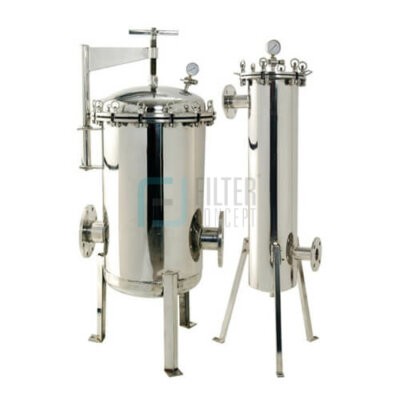
Filter Concept’s engineered solution for power plant BFW pre-treatment is a Multi-Bag Filter Housing assembly installed downstream of the raw water clarifier and multimedia filter, but upstream of the cation exchange / RO / mixed-bed deionisation train. The architecture is purposefully matched to the flow variability and contamination profile of real power plant water systems.
Multi-bag configuration. 4, 8, 16, 24, or 32-bag housings sized to actual peak make-up demand with N+1 redundancy. Each bag isolates individually for changeout while the rest of the housing carries flow. Differential pressure indicators per bank guide changeout timing. Quick-release davit lid for rapid changeout under PPE-protected operations — critical when plant chemistry teams are managing changeout against an active deionisation cycle.
Engineered media selection. Polyester or polypropylene felt bags at 5–25 micron for general TSS-dominant make-up streams. Glass fibre bags at 1–5 micron where the upstream water source carries elevated colloidal iron oxide. FCPL specifies the media grade from your actual feed water iron, silica, and TSS profile rather than from a generic catalogue — the difference between adequate and excellent on this service.
SS 316L housing matched to chemistry. Stainless steel 316L for general demin water pre- polishing service. Optional SS 304 for upstream raw water polishing where corrosion exposure is lower. Optional EN 10204-3.1/3.2 material certification for European jurisdictions. IBR- stamped designs for Indian power plant statutory compliance. Pressure rating to 10 bar covers the full range of BFW pre-treatment system pressures.
FaaS service model. Annual service includes bag inventory management, changeout scheduling aligned to plant boiler chemistry monitoring, differential pressure data logging for plant reliability KPIs, and Sustainable Filters bag recovery for circular economy reporting. The plant receives a documented preventive maintenance log that supports CEA / NERC / EU IED documentation requirements.
FC-PDS™ specification methodology. Bag count, micron rating, and media type are specified from your actual make-up water analysis (TSS, iron, silica, organic carbon), peak and average flow demand, and downstream DM plant resin specification. Site-specific engineering produces the iron oxide capture efficiency that DM resin protection requires.
Engineering Specifications at a Glance
| Parameter | Specification |
| Housing Material | SS 316L (demin water service) or SS 304 (pre-DM polishing) |
| Filter Media (Standard) | Polyester / Polypropylene Felt Bags — 5 to 25 micron |
| Filter Media (High Spec) | Glass Fibre Bag Media for fine pre-DM polishing (1–5 micron) |
| Configuration | Multi-bag (4, 8, 16, 24, 32 bag) housings sized to make- up flow demand |
| Flow Rate | 100 to 5,000 ms/day (matched to plant make-up rate) |
| Operating Pressure | Up to 10 bar |
| Operating Temperature | Ambient to 80°C continuous service |
| Outlet TSS | Less than 5 mg/L (DM resin protection threshold) |
| Iron Capture Efficiency | Greater than 95% on iron oxide particulate |
| Pressure Vessel Code | ASME Section VIII Div. 1 / IBR / PED 2014/68/EU compatible |
| Closure | Quick-release davit lid for rapid bag changeout |
| Service Model | FaaS + Sustainable Filters (lifecycle bag inventory management) |
Operational and Commercial Outcomes
Power plants that install a properly specified Multi-Bag Filter Housing on the BFW pre- treatment train see returns concentrated across DM operation, boiler reliability, and heat rate
- typically within the first six months:
- DM resin life extended by 30–60% — deferring resin replacement events at USD 8,000–30,000 per vessel, recovering significant annual capex from the maintenance
- Boiler tube failure frequency reduced — a single avoided tube rupture (USD 200K–500K repair plus generation outage) typically pays back the entire filtration investment many times over.
- Heat rate degradation rate slowed — boiler chemical cleaning interval extended from typical 18–24 months to 36–48 months, deferring USD 200,000–500,000 in cleaning chemical and outage cost per
- Generation availability protected — unplanned outages from BFW contamination eliminated, securing capacity revenue and grid reliability KPIs under NERC, CEA, and equivalent frameworks.
- Statutory compliance documentation strengthened — IBR Form III water quality records, ASME Section I water chemistry logs, and EN 12952 boiler operating documentation all benefit from documented filtration performance data.
For a 500 MW thermal unit, the combined annual return from DM resin life extension, boiler tube event avoidance, and heat rate sustained typically exceeds USD 1 to 3 million — against a Multi-Bag Filter Housing investment that recovers in well under a single avoided boiler tube event. Across FCPL’s power plant installed base, this is consistently one of the lowest-risk capital decisions on the utilities engineer’s desk.
Global Standards & Regional Compliance Matrix
Power plant BFW polishing sits at the intersection of pressure equipment safety (boilers operate at IBR / ASME Section I jurisdictional class), water quality regulation, and grid reliability requirements. The FCPL Multi-Bag Filter Housing is engineered to international baselines with regional certifications added per destination market:
| Region / Cluster | Applicable Standards & Regulations |
| International (Universal) | ASME Section I (Power Boilers) · ASME Section VIII Div. 1 · ASME PTC 12.2 · IEC 60079 (hazardous areas) · ISO 14001 · IEEE Power Generation standards |
| North America | ASME BPVC Sections I & VIII · NERC reliability standards · EPA Steam Electric Effluent Guidelines · NFPA 850 (fire protection in power plants) |
| Europe | PED 2014/68/EU · EN 12952 (water-tube boilers) · EN 12953 |
| Region / Cluster | Applicable Standards & Regulations |
| (shell boilers) · EU Industrial Emissions Directive · BAT Reference for Large Combustion Plants | |
| Middle East & GCC | Saudi Aramco SAES-K-001 (utility water) · ADWEA / DEWA technical specifications · KAHRAMAA boiler standards · SASO certification · GCC Power Grid technical codes |
| Africa | Eskom NRS standards (South Africa) · SABS · NERC Nigeria · EPRA Kenya · NEMA environmental standards |
| Asia-Pacific & India | IBR (Indian Boiler Regulations) · IS 1554 (BFW Quality Standards) · CEA Thermal Power Plant Performance Standards · PESO certification · PETRONAS / TNB engineering specs (SE Asia) · Japan JIS B 8201 |
| Latin America | Brazil ABNT NBR power plant standards · ANP / ANEEL specifications · Pemex CFE specifications (Mexico) |
Two standards frameworks deserve specific attention. The Indian Boiler Regulations (IBR) impose statutory water chemistry limits with periodic inspection consequences for non- compliance — making BFW filtration documentation directly load-bearing for plant operating licences. ASME Section I in North America, EN 12952 in Europe, and JIS B 8201 in Japan converge on similar prescriptive water quality limits. The FCPL housing is engineered to satisfy all four — making it a genuinely global power plant supply specification.
The Bottom Line for Plant Heads, Utilities Engineers, and Asset Managers
BFW polishing is one of the rare power plant retrofit decisions where the engineering case, the regulatory case, the energy case, and the reliability case all point in the same direction. The cost of getting it wrong is not a maintenance line item — it is boiler tube events, DM resin replacement cascades, heat rate degradation, and generation outages that compound across the asset lifecycle. The cost of getting it right is a fraction of any one of those exposures.
Filter Concept has been engineering power plant filtration solutions for the global generation sector for over twenty-three years, with installations across thermal, combined cycle, gas turbine, and large industrial cogeneration plants in 90+ countries. Customers include national power utilities, IPPs, EPC contractors, and combined-cycle developers from NTPC and Adani Power to ACWA Power, DEWA, KAHRAMAA, ENGIE, and Petrobras combined-cycle assets. The Multi-Bag Filter Housing for BFW pre-treatment service is one of our most engineered, most repeated installations — because BFW chemistry requirements are universal, but the discipline of engineering a multi-bag housing for real power plant make-up variability is rare in the global filtration market.
If your DM resin replacement frequency has crept upward, if your last boiler tube inspection raised flags on iron deposition, or if your unit heat rate has trended unfavourably over the operating cycle — your BFW pre-treatment polishing is the first place to look. We are happy to review your make-up water analysis and offer a specification at no obligation, anywhere in the world.
TALK TO OUR POWER PLANT FILTRATION TEAM
Send us your make-up water analysis (TSS, iron, silica, organic carbon, peak and average flow), unit rating, and current DM resin replacement history. We will return a sized FC-PDS™ specification, multi-bag housing P&ID, and an indicative annual savings calculation — within 5 working days. Service available across 90+ countries.
ABOUT THE AUTHOR
Mehul J Panchal is the Founder of Filter Concept Group, a global industrial filtration manufacturer serving 5,000+ customers across 90+ countries with 23+ years of engineering depth. The company’s product portfolio spans 50+ industries including oil & gas, LNG, petrochemicals, power, water treatment, pharmaceuticals, and food processing. Mehul writes on filtration economics, process engineering, and the practical realities of running filtration systems at industrial scale.