
By Mehul J Panchal, Founder, Filter Concept Group | 9-minute read | Oil & Gas Filtration Series
Cooling water is the most underestimated utility in any large refinery, petrochemical complex, or process plant. It runs in the background, drawn from a cooling tower basin and pushed through tens of thousands of heat exchanger tubes at flow rates of 10,000 to 100,000 cubic metres per hour. Nobody thinks about it until heat transfer efficiency degrades, energy bills climb, exchangers need cleaning, or — in the most expensive scenario — the cooling tower fill packing becomes colonised by mussels, clams, or algae mats and the entire basin needs draining.
Across coastal refineries from Mumbai to Yanbu, from Singapore to Cilacap, the cooling water return line carries a remarkable inventory of macro-debris: algae mats and biological floc, scale flakes spalled from heat exchanger tubes during seasonal cycling, mussel and Asiatic clam shells from biofilm colonisation, rubber expansion joint fragments, plastic maintenance debris, and seasonal organic matter from cooling tower deposition. Almost none of these are caught by the basin sump. Almost all of them recirculate. And the cumulative effect, over a single operating cycle, is heat exchanger efficiency degradation that costs the average refinery USD 500,000 to 1,500,000 per year in additional energy consumption alone. This article explains why a Scraper Mechanism Self-Cleaning Filter on the cooling water return header has become the engineered global answer for this problem, and why it is one of the highest-payback retrofit investments available to refinery utilities engineers today.
The Hidden Economics of Cooling Water Macro-Debris
Cooling water systems are a quiet, compounding cost centre. Three failure modes drive the economics, and each one is independently expensive.
Failure mode one: heat exchanger efficiency degradation. Macro-debris in cooling water deposits on tube-side surfaces of process heat exchangers, building a fouling layer that reduces heat transfer coefficient by 15 to 25 percent within six months of operation. Process outlet temperatures climb. Compressors run hotter. Distillation columns flood at lower throughput. Energy consumption rises. A 10 percent reduction in heat exchanger efficiency across a major refinery cooling system increases energy consumption by USD 500,000 to 1,500,000 per year — a number that does not appear in any single equipment line item but bleeds through the refinery’s entire energy balance.
Failure mode two: cooling tower basin fouling and biological colonisation. Coastal refineries using seawater make-up face mussel and Asiatic clam colonisation as a recurring and expensive operational problem. Mussel colonies attach to tower fill packing, reducing air flow and water distribution uniformity. Full cooling tower basin cleaning costs USD 80,000 to 200,000 per event and is required every 12 to 18 months without macro-debris management. Inland refineries face the algae and biological floc equivalent — less visible, equally expensive in cumulative effect.
Failure mode three: hydrojetting risk and exchanger isolation costs. Mechanical cleaning of fouled exchangers requires hydrojetting at 600 to 1,000 bar — a high-risk activity under hot work permit that every refinery tries to minimise. Exchanger isolation events for cleaning typically cost USD 50,000 to 150,000 each, with two to four required per year per fouled unit. The entire cooling water side of refinery maintenance becomes a recurring outage management exercise that nobody enjoys planning.
Adding to this: Legionella risk management. Under ASHRAE 188 in North America, BS 8580 in the UK, VDI 2047 in Germany, and CPCB cooling water guidelines in India, biofilm on cooling tower surfaces is now treated as a Legionella amplification risk requiring documented control. Macro-debris that accumulates in the cooling system is biofilm substrate. Regulatory inspections increasingly ask for filtration system documentation as evidence of biological riskcontrol — a documentation requirement that under-specified cooling water systems cannot satisfy.
Why Conventional Filtration Cannot Solve Cooling Water Macro-Debris
Three constraints make cooling water return line filtration uniquely demanding, and explain why generic filtration suppliers consistently get this wrong:
- Continuous, high-flow service. Cooling water return headers run at 8,760 hours per year. Flow rates of 5,000 to 20,000 ms/hr per header are normal at major refineries. Disposable cartridge filters are economically and operationally impossible at this scale. The only viable architecture is a continuous self-cleaning system that does not interrupt flow.
- Macro-debris, not micron-level The contamination is mussel shells, algae mats, scale flakes — millimetre-scale debris, not micron-level fines. The engineered answer is not a fine cartridge or a bag filter. It is a perforated screen at
0.5 to 3 mm with a mechanical cleaning system that can handle the scale of solid waste involved.
- Backwash water unavailability. Many refineries already operate cooling water systems near their make-up water A backwash-style self-cleaning filter that consumes 5–10 percent of the filtered flow as cleaning water creates a make-up water demand that the plant cannot supply economically. The Scraper Mechanism approach uses zero backwash water — the rotating scraper blade physically displaces debris off the screen surface to a bottom strainer pot for periodic manual cleanout.
These three constraints together explain why conventional refinery filtration suppliers’ default to undersized strainers (which clog daily and need manual cleaning) or skip the cooling water return line entirely (which delivers the energy and Legionella consequences described above). Solving it correctly requires a purpose-engineered solution that exists outside generic filtration product lines. That is precisely the gap FCPL’s Scraper Mechanism Self-Cleaning Filter is designed to fill.
The FCPL Solution: Scraper Mechanism Self-Cleaning Filter
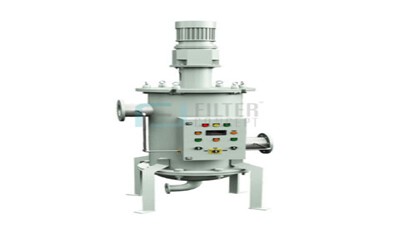
Filter Concept’s engineered solution for cooling water return line service is a Scraper Mechanism Self-Cleaning Filter Housing installed on the return header upstream of the cooling tower basin. The architecture is mechanical, continuous, and water-conservative — specifically designed for the realities of refinery cooling water service.
Continuous mechanical scraping, no backwash water. A motor-driven rotating scraper blade continuously sweeps the inside surface of the perforated screen, displacing macro-debris off the screen and into a bottom strainer pot. The scraper runs 24/7 in continuous duty
(rated for 8,760 hours per year operation) at low power consumption (0.55 to 2.2 kW depending on housing size). Zero backwash water is consumed — a critical advantage in water-stressed regions and a documented compliance benefit under water-conservation reporting frameworks.
Coarse perforated screen, sized to the protection criterion. Screen openings are specified in the 0.5 to 3 mm range — sized not to remove fine particulate but to capture macro-debris before it reaches downstream heat exchanger tubes. The protection criterion is the heat exchanger tube internal diameter; FC-PDS™ sizes the screen opening accordingly to ensure no debris larger than the exchanger tolerance reaches the tubes.
Materials matched to cooling water chemistry. Carbon steel housing with epoxy internal lining provides the structural rating at economic cost. The screen itself is SS 316L for biocide and chloride compatibility — essential because cooling water is chemically treated with chlorine, glutaraldehyde, or oxidising biocide blends to manage Legionella. The scraper assembly bearings and seals are rated for continuous biocide exposure with annual service intervals.
Sized for the full return header. Single units handle 500 to 20,000 ms/hr per housing. Larger refinery cooling systems use multiple units in parallel header configuration with N+1 redundancy. FCPL’s engineering team sizes the unit count from the actual cooling water flow demand, header pressure profile, and biocide cycle frequency.
FaaS service model. Annual service includes scraper bearing inspection, motor seal replacement, screen integrity check, and biocide compatibility verification. The plant receives a documented preventive maintenance log that supports both ASHRAE 188 / BS 8580 Legionella documentation and refinery reliability KPIs. Sustainable Filters extension recovers and recycles displaced debris waste streams where applicable.
Engineering Specifications at a Glance
| Parameter | Specification |
| Housing Material | CS with epoxy-lined internal surface (cooling water service) |
| Screen Material | SS 316L perforated plate — 0.5 to 3 mm openings |
| Cleaning Mechanism | Motor-driven rotating scraper blade — 24/7 continuous duty |
| Flow Rate | 500–20,000 ms/hr per housing |
| Power Consumption | 0.55 to 2.2 kW (scraper motor) |
| Backwash Water | Zero — mechanical scraper, no backwash water consumed |
| Operating Pressure | Up to 10 bar |
| Operating Temperature | Ambient — 60°C continuous service |
| Debris Discharge | Bottom strainer pot for periodic manual cleanout |
| Biocide Compatibility | Chlorine, glutaraldehyde, oxidising and non-oxidising treatments |
| Pressure Vessel Code | ASME Section VIII Div. 1 / PED 2014/68/EU compatible |
| Service Model | Retrofit + FaaS (annual scraper bearing & seal service) |
Operational and Commercial Outcomes
Refineries that install a properly sized Scraper Mechanism Self-Cleaning Filter on the cooling water return header see returns concentrated in five distinct areas, all measurable against pre-installation baseline data:
- Heat exchanger fouling rate reduced by 50–80% — hydro jetting cleaning frequency falling from 2–4 events per exchanger per year to 0–1 event per year per train, recovering USD 200,000 to 600,000 in cleaning costs annually.
- Energy consumption recovery of USD 500,000 to 1,500,000 per year from sustained heat exchanger efficiency — by far the largest line item in the savings calculation, and the one that drives executive-level interest in this retrofit.
- Cooling tower basin cleaning frequency extended from 12–18 months to 36–60 months — saving USD 80,000 to 200,000 per avoided basin cleaning event.
- Mussel and biological colonisation of tower fill prevented — critical at coastal refineries where the alternative is annual fill packing replacement at USD 250,000 to 500,000.
- Legionella risk documentation strengthened — the FaaS service log provides direct compliance evidence under ASHRAE 188, BS 8580, VDI 2047, and CPCB Legionella guidelines.
For a major refinery operating a 50,000+ ms/hr cooling water system, the combined annual savings from energy recovery, exchanger cleaning avoidance, and basin maintenance extension typically exceed USD 1.5 to 3 million. The Scraper Mechanism Self-Cleaning Filter capital investment recovers in well under twelve months — often within a single avoided cooling tower basin cleaning event. This is one of the highest-payback retrofit investments available to refinery utilities engineers today, and one that consistently surprises management teams with the speed of its return.
Global Standards & Regional Compliance Matrix
Cooling water filtration sits at the intersection of three regulatory domains: pressure equipment safety, electrical safety in hazardous areas (because cooling water systems often run adjacent to hydrocarbon-classified zones), and — increasingly — Legionella biological risk management. The FCPL Scraper Mechanism Self-Cleaning Filter is engineered to international baselines with regional certifications added per destination market:
| Region / Cluster | Applicable Standards & Regulations |
| International (Universal) | ASHRAE 188 (Legionella risk management) · ASME Section VIII Div. 1 · ISO 14001 environmental management · IEC 60079 (hazardous area motors) · ATEX 2014/34/EU · IECEx |
| North America | ASHRAE 188 (Legionellosis Standard) · OSHA cooling water guidelines · EPA NPDES cooling water discharge · NFPA 70 (NEC) · NACE TM0286 (cooling water corrosion testing) |
| Europe | PED 2014/68/EU · EU Legionella Working Group guidelines · BS 8580 (Legionella risk assessment) · VDI 2047 (Germany cooling tower hygiene) · EN 13443 |
| Middle East & GCC | Saudi Aramco SAES-K-001 (cooling water systems) · ADNOC HSE-MS specifications · KOC technical standards · QatarEnergy specifications · SASO certification |
| Africa | SABS South Africa cooling water standards · NESREA Nigeria · NEMA Kenya · Sonangol Angola facility specifications |
| Asia-Pacific & India | CPCB Legionella cooling water guidelines · IS 12021 (cooling water treatment) · OISD-109 (refinery safety) · IBR pressure equipment · PESO certification · Singapore NEA cooling tower guidelines |
| Latin America | Brazil ABNT NBR cooling water standards · Petrobras N-2624 · Pemex NRF specifications · ANP Brazil |
Two standards have become dominant globally and deserve specific mention. ASHRAE 188
— originally a U.S. standard — is now referenced as the de facto global benchmark for Legionella risk management in industrial cooling, including by international insurers when underwriting industrial property risk. BS 8580 in the U.K. and VDI 2047 in Germany are converging on similar requirements. The Scraper Mechanism Self-Cleaning Filter’s annual service log directly supports compliance under all three.
The Bottom Line for Utilities Engineers and Energy Managers
Cooling water filtration is one of the rare retrofit decisions where the energy case alone justifies the investment, before any of the other benefits are counted. The exchanger cleaning avoidance is a bonus. The basin cleaning frequency extension is a bonus. The Legionella documentation is a bonus. The mussel colonisation prevention is a bonus. Strip all of those out and the energy savings alone deliver a payback inside twelve months at any major refinery globally.
Filter Concept has been engineering cooling water filtration solutions for the global oil and gas, petrochemical, and power generation sectors for over twenty-three years, with installations across major refining and process clusters in 90+ countries. Customers include national oil companies, international majors, EPC contractors, and combined-cycle power generators from the U.S. Gulf to Saudi Aramco refineries, ADNOC Ruwais, Reliance Jamnagar, Petronas Pengerang, and Petrobras refining. The Scraper Mechanism Self-Cleaning Filter for cooling water service is one of our most engineered installations — because the chemistry and biology of cooling water are universally messy, but the discipline of solving them with a continuous, water-conservative, mechanical scraper system is rare in the global filtration market.
If your heat exchanger cleaning frequency has crept upward over the last operating cycle, if your cooling tower basin needs annual or semi-annual cleaning, or if your last energy audit flagged exchanger fouling as an unaddressed efficiency loss — your cooling water return line filtration is the first place to look. We are happy to review your cooling water flow data and offer a specification at no obligation, anywhere in the world.
TALK TO OUR COOLING WATER FILTRATION TEAM
Send us your cooling water system data (return header flow rate, current biocide regime, last 12 months exchanger cleaning frequency, basin cleaning history) and your heat exchanger tube ID specification. We will return a sized FC-PDS™ specification, a P&ID schematic showing scraper installation point, and an indicative annual energy savings calculation — within 5 working days. Service available across 90+ countries.
ABOUT THE AUTHOR
Mehul J Panchal is the Founder of Filter Concept Group, a global industrial filtration manufacturer serving 5,000+ customers across 90+ countries with 23+ years of engineering depth. The company’s product portfolio spans 50+ industries including oil & gas, LNG, petrochemicals, power, water treatment, pharmaceuticals, and food processing. Mehul writes on filtration economics, process engineering, and the practical realities of running filtration systems at industrial scale.