
By Mehul J Panchal, Founder, Filter Concept Group | 9-minute read | Food & Beverage Filtration Series
Across the global food and beverage industry — from Coca-Cola and PepsiCo bottlers to Nestlé packaged water plants, from Diageo to AB InBev, from local mineral water brands to global dairy operations — the single utility that touches every finished product is process water. The quality envelope for that water is now governed by FSSAI in India, FDA 21 CFR 174-186 in the U.S., EFSA in the EU, GCC SFDA, and a network of national food safety authorities that have spent the last decade tightening particulate, microbial, and TOC thresholds in line with consumer expectations and ESG-linked retailer audits.
What sits between the RO permeate tank and the bottling line filler valve, between the brewery sparge water tank and the wort kettle, between the dairy CIP tank and the product contact line, is in every case a final polishing cartridge filter. Get it right and the bottling line runs at design throughput with audit-grade documentation. Get it wrong — specify a generic industrial cartridge without FDA-compliant binders, sanitary tri-clamp geometry, or CIP-compatible internal surfaces — and the next FSSAI inspection, the next FDA Form 483, or worse, the next consumer complaint of visible particulate in a sealed beverage bottle, becomes a recall event. This article explains why a properly engineered Sanitary Cartridge Filter Housing has become the global engineering standard for beverage process water final polishing, and why the cost of getting it wrong is measured in product recall exposure rather than equipment cost.
The Hidden Economics of Beverage Process Water Failure
Three numbers explain why beverage final polishing filtration deserves first-rank capital and engineering attention rather than last-rank procurement consideration.
Failure mode one: bottling line rejection. Bottling lines run at 12,000 to 36,000 bottles per hour. Visible particulate in clear PET bottles — mineral micro-precipitates, post-RO biofilm flakes, SS piping corrosion particles — triggers 100% visual inspection rejection under BIS 13428 and equivalent global packaged water standards. Even a 0.5% rejection rate represents 60 to 180 rejected bottles per hour and USD 180 to 540 per hour in direct product waste at premium pricing. Across a 16-hour bottling shift, this compounds to USD 3,000 to 9,000 in daily waste — against a polishing cartridge that costs a fraction of one day’s waste.
Failure mode two: consumer-level recall. Particulate or microbial breakthrough that reaches finished product triggers consumer complaints, retail shelf rejection, and — in the worst case — a Class II or Class I product recall. Recall costs for a single SKU at a major brand range from USD 60,000 to 600,000 in direct product write-off, plus brand damage that is difficult to quantify but consistently exceeds the direct cost by 5–10×. For e-commerce-sold brands operating on Amazon, Flipkart, and equivalent platforms, the negative review cascade from one contamination event measurably affects subsequent quarter sales.
Failure mode three: regulatory audit findings. FSSAI HACCP audits, FDA cGMP inspections, EU EFSA reviews, and equivalent jurisdictional audits all examine process water filtration documentation. Inadequate post-RO filtration appears repeatedly as a Critical Control Point gap — the level that triggers conditional license renewal or temporary production suspension until remediated. For export-grade beverage manufacturers, the documentation gap also threatens market access to regulated destination markets.
Why Generic Cartridges Fail on Beverage Final Polishing Service
Beverage process water is not industrial process water. It is a regulated food contact utility with prescriptive material requirements that generic cartridges consistently fail to satisfy. Three failures recur across global beverage industry audits:
- Non-food-grade element binders. Generic polypropylene cartridges use thermal binders and surface treatments that contribute extractables to the filtered stream — trace BHT, antioxidants, and processing residues that fail FDA 21 CFR and FSSAI food contact The engineered answer is FDA-compliant PP melt-blown media with documented extractables certification and food-contact compliance per the destination market’s regulatory framework.
- Industrial housing Threaded NPT connections, flanged ANSI interfaces, and non-drainable internal surfaces are incompatible with the daily CIP cycles that beverage operations run as standard practice. Stagnant water in dead legs harbours biofilm; thread voids harbour bacterial growth between sanitation cycles. The engineered answer is sanitary tri-clamp connections, fully drainable geometry, and electropolished internal surfaces — the same design principles ASME BPE codifies for pharmaceutical service, adapted for beverage operating reality.
- Nominal rating instead of absolute rating. Generic cartridges marketed at 1-micron nominal pass 30–60% of particles in that size range. Beverage final polishing requires absolute-rated cartridges that capture defined particle sizes at certified efficiency — the difference between marketing claim and audit-grade performance is the difference between bottling line yield and bottling line rejection.
Each of these failures is independently sufficient to fail a food safety audit. The compounding effect of all three is what produces the recurring quality issues that haunt beverage operators relying on cost-driven generic filtration suppliers.
The FCPL Solution: Sanitary Cartridge Filter Housing for Beverage Final Polishing
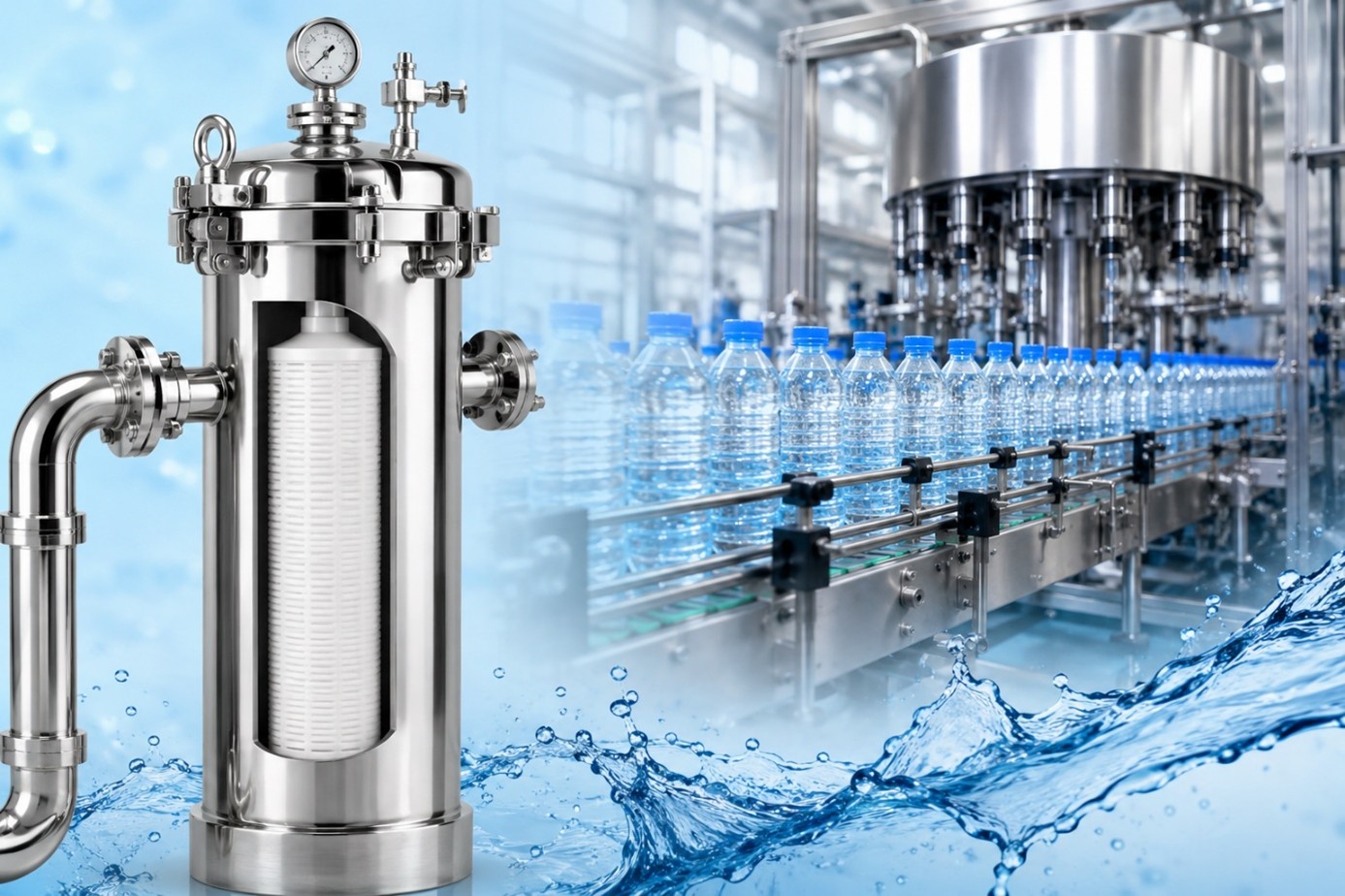
Filter Concept’s engineered solution for beverage final polishing is a Sanitary Cartridge Filter Housing installed at the bottling line inlet or at the RO permeate tank outlet, depending on plant architecture. Every design element is matched to global food safety regulatory requirements.
SS 316L sanitary geometry. Internal surface electropolished to food-contact specification. Fully drainable design with no dead legs. Sanitary tri-clamp connections (1” to 3”) sized to the bottling line flow demand. CIP-compatible without disassembly — the housing tolerates daily caustic and acid sanitation cycles in place.
Absolute-rated FDA-compliant PP cartridge. 0.5-to-5-micron absolute polypropylene melt- blown media with FDA 21 CFR 174-186 compliance, FSSAI food contact certification, and full extractables study documentation. Captures mineral micro-precipitates, post-RO biofilm flakes, and SS piping corrosion particles with documented retention efficiency. Element changeout governed by differential pressure indicator, not elapsed time — extending element life while providing trend data for the HACCP CCP log.
HACCP CCP validation support. FCPL provides a Critical Control Point validation template that integrates directly into the plant’s HACCP documentation. The cartridge is positioned as a CCP within the food safety management plan, with prescribed monitoring frequency, corrective action protocols, and verification records that satisfy FSSAI, FDA, EU, and equivalent audit requirements.
Integrity test capability. Optional integrity test port for membrane QC verification — a critical feature for plants supplying export markets where retained sample testing of filter integrity is a documented requirement.
FC-PDS™ specification methodology. Cartridge micron rating, element count, and changeout frequency are specified from your actual post-RO water quality, bottling line flow demand, and product specification. Site-specific engineering produces the absolute retention efficiency that audit-grade beverage operations require.
Engineering Specifications at a Glance
| Parameter | Specification |
| Housing Material | SS 316L — electropolished food-contact internal surface |
| Filter Media | Polypropylene melt-blown cartridge — 0.5-to-5-micron absolute |
| Connections | Sanitary tri-clamp 1” to 3” (food industry standard) |
| Internal Geometry | Fully drainable — zero dead legs (FSSAI/FDA design rules) |
| Flow Rate | 1 to 20 ms/hr per housing |
| Operating Temperature | Ambient — 80°C; CIP cycle to 90°C |
| CIP Compatibility | NaOH 2% caustic, HNO₃ 0.5–1% acid, peracetic acid 0.3% |
| Compliance | FDA 21 CFR 174-186 · FSSAI food contact · NSF/ANSI 61 · EU Reg. 10/2011 |
| Documentation | Extractables certificate, material 3.1 certificate, food contact compliance |
| HACCP Support | CCP validation template provided |
| Service Model | Sustainable Filters + FaaS (lot-traced element supply on AMC) |
Global Standards & Regional Compliance Matrix
Beverage final polishing filtration sits at the intersection of food contact regulation, hygienic equipment design, and — increasingly — ESG-linked retailer audit requirements. The FCPL Sanitary Cartridge Filter Housing is engineered to international baselines with regional certifications added per destination market:
| Region / Cluster | Applicable Standards & Regulations |
| International (Universal) | ISO 22000 (Food Safety Management) · Codex Alimentarius General Principles · ISO 14159 (Hygienic Design) · NSF/ANSI 61 · EHEDG hygienic design |
| North America | FDA 21 CFR 174-186 (food contact substances) · FDA FSMA · USDA FSIS regulations · NSF International certification · cGMP for foods |
| Europe | EU Regulation 10/2011 (plastic food contact) · EU 1935/2004 (food contact materials) · EFSA opinions · EHEDG hygienic equipment design · BRCGS Food Safety |
| Middle East & GCC | GSO conformity · SFDA Saudi food safety · UAE ESMA food contact · Qatar GORD · Halal certification frameworks |
| Africa | South Africa SABS food contact · Nigeria NAFDAC · Kenya KEBS food safety · Egypt EOS · African Continental Free Trade food standards |
| Asia-Pacific & India | FSSAI Food Safety Regulations · BIS 13428 / IS 14543 packaged water · BIS IS 4251 · Japan PMDA food contact · China GB 4806 · Singapore SFA |
| Latin America | Brazil ANVISA RDC 91/2001 · Mexico COFEPRIS food contact · Argentina ANMAT · MERCOSUR food contact framework |
Two regulatory frameworks have emerged as global benchmarks. FDA 21 CFR food contact regulations are widely referenced even in non-U.S. jurisdictions, particularly for export-grade beverage manufacturers. EU Regulation 10/2011 sets the global plastic food contact standard. NSF/ANSI 61 has become the universal materials standard for water-contact equipment. The FCPL housing satisfies all three — making it qualifiable across major global beverage procurement environments without separate regional certifications.
The Bottom Line for Beverage Quality Managers and Plant Engineers
Beverage final polishing is the rare engineering decision where the food safety case alone justifies the investment, before any of the operational benefits are counted. The cost of getting it wrong is not a maintenance line item — it is recalling exposure, brand damage, regulatory audit consequence, and market access risk. The cost of getting it right is a fraction of any one of those exposures.
Filter Concept has been engineering food and beverage and industrial filtration solutions for the global sector for over twenty-three years, with installations across packaged water, soft drinks, brewery, dairy, and food processing operations in 90+ countries. Customers include national bottling franchises of major global beverage brands, premium packaged water producers, brewery operations, and dairy manufacturers across India, GCC, Southeast Asia, Africa, and Latin America. The Sanitary Cartridge Filter Housing for beverage final polishing is one of our most engineered, most validated, and most repeated installations — because food safety requirements are universal, but the discipline of engineering FDA-compliant geometry with HACCP-grade documentation is rare in the global filtration market.
If your last FSSAI/FDA/EU audit raised any flags on process water filtration, if your bottling line rejection rate has crept upward, or if your last consumer complaint cycle included particulate-related issues — your beverage final polishing filter is the first place to look. We are happy to review your post-RO water quality and bottling line specification, and offer a sized FC-PDS™ specification at no obligation, anywhere in the world.
TALK TO OUR FOOD & BEVERAGE FILTRATION TEAM
Send us your post-RO water quality data, bottling line flow demand, product specification (mineral water/soft drink/brewery/dairy), and HACCP audit history. We will return a sized FC-PDS™ specification, sanitary housing P&ID, and HACCP CCP validation template — within 5 working days. Service available across 90+ countries.
ABOUT THE AUTHOR
Mehul J Panchal is the Founder of Filter Concept Group, a global industrial filtration manufacturer serving 5,000+ customers across 90+ countries with 23+ years of engineering depth. The company’s product portfolio spans 50+ industries including oil & gas, LNG, petrochemicals, power, water treatment, pharmaceuticals, and food processing. Mehul writes on filtration economics, process engineering, and the practical realities of running filtration systems at industrial scale.