
By Mehul J Panchal, Founder, Filter Concept Group | 9-minute read | Cosmetics & Personal Care Filtration Series
From L’Oréal to Estée Lauder, from HUL to Mamaearth, from Beiersdorf to Forest Essentials, the global cosmetics industry now operates under ISO 22716 GMP as the universal manufacturing standard, with the EU Cosmetics Regulation 1223/2009, FDA cGMP for cosmetics, India’s CDSCO Cosmetics Rules 2020, and equivalent jurisdictional frameworks layered on top. The single utility that determines whether a 100-kilogram emulsion batch reaches the filling line as audit-grade product or as a deviation report is the pre-fill polishing filter — the engineering interface between high-shear emulsification and precision filling machinery.
Cosmetic emulsions — moisturisers, sunscreens, hair conditioners, body lotions, serums — are produced by hot-cold emulsification of oil phase in water phase using high-shear homogenisers, then transferred at 40–70°C to filling machines that meter 50 to 5,000 units per hour through 0.5 to 2 millimetre orifices. Undissolved wax beads from incomplete melt cycles, polymer microparticles from old microbead inventory, and metal fragments from homogeniser blade wear all create three independent failure modes: gritty consumer experience that drives one-star reviews, filling machine nozzle blockage that halts production at USD 600 to 3,600 per hour, and Cosmetics Rules visible-particle non-conformances that trigger CDSCO and FDA Form 483 findings. This article explains why a properly engineered Cartridge Filter Housing has become the global engineering standard for cosmetic emulsion pre-fill polishing.
The Hidden Stakes of Cosmetic Filtration Failure
Three numbers drive the economics of cosmetic pre-fill filtration, each independently sufficient to justify the engineering investment.
Stake one: filling line nozzle blockage and line downtime. Cosmetic filling machines operate with precision 0.5–2 mm nozzle orifices that block within hours on undissolved wax or polymer particulate. Line downtime for nozzle cleaning costs USD 600 to 3,600 per hour at major brand operations — the line stoppage, the operator intervention, the deferred filling schedule cascade, and the in-process inventory waste all compound into a number that nobody puts on a procurement justification but everyone in production accepts as a recurring cost.
Stake two: consumer experience failure and e-commerce reviews. Gritty texture in cream products, visible wax inclusions in clear serums, polymer fragments in roll-on applicators — all detected by consumers, all returned to retailers, all reviewed on Amazon, Flipkart, Tira, Sephora, and equivalent platforms. The brand consequence of consistent particulate complaints in a category dependent on premium positioning compounds against future sales in ways that classical maintenance cost accounting does not capture.
Stake three: regulatory audit findings. ISO 22716 GMP audits, FDA cGMP inspections, EU Cosmetics Regulation reviews, and CDSCO Cosmetics Rules 2020 audits all examine in- process filtration documentation. Visible particles in clear gel cosmetics is a documented Cosmetics Rules non-conformance under the Drugs and Cosmetics Act — the type of finding that triggers conditional manufacturing licence renewal. For export-grade Indian cosmetic manufacturers expanding into U.S. and EU markets, ISO 22716 certification with documented process filtration is now table stakes.
Why Generic Cartridges Fail on Cosmetic Service
Cosmetic process filtration faces three constraints that generic industrial cartridges consistently fail to satisfy:
- Non-cosmetic-grade element Generic cartridges use processing residues, BHT antioxidants, and surface treatments that fail Cosmetics Rules 2020 ingredient traceability requirements — anything that contributes extractables to the finished product must appear on the ingredient declaration. The engineered answer is FDA Cosmetics-grade PP media with documented extractables certification and full ingredient traceability per the destination market’s regulatory framework.
- High-viscosity, high-temperature service incompatibility. Cosmetic emulsions are 1,000 to 25,000 cP at 50–70°C — a service regime where generic cartridge housings experience seal failures, element collapse, and bypass at the cartridge gasket. The engineered answer is high-temperature aramid or EPDM seals, reinforced element support, and SS 316L housing geometry that handles the actual cosmetic emulsion service window.
- Incompatibility with daily CIP. Cosmetic operations run CIP cycles between every product changeover — typically several times per day on multi-product Generic housings with threaded connections and non-drainable internal geometry harbour residual product between cycles, leading to cross-contamination between fragrance lines and to bacterial growth in skincare lines. The engineered answer is full ASME BPE-style drainability and sanitary tri-clamp connections, validated for daily caustic and peracetic acid sanitation cycles.
Each of these failures is independently sufficient to fail an ISO 22716 audit. Their combined effect is what produces the recurring quality issues at cosmetic operators relying on generic industrial filtration suppliers.
The FCPL Solution: Sanitary Cartridge Filter Housing for Cosmetic Pre-Fill
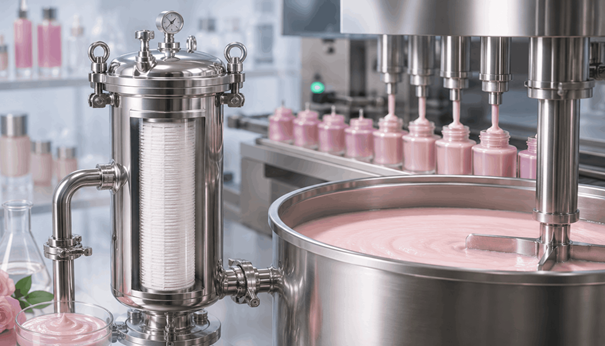
Filter Concept’s engineered solution for cosmetic emulsion pre-fill is a Sanitary Cartridge Filter Housing installed on the emulsion transfer header between the homogeniser/mixing vessel and the filling machine. Every design element is matched to global cosmetic regulatory and engineering reality.
SS 316L sanitary geometry with high-temperature seals. Internal surface electropolished to cosmetic-contact specification. Fully drainable design. Aramid or platinum-cured silicone seals rated for the actual emulsion service temperature (up to 80°C continuous). Sanitary tri- clamp connections sized to the transfer flow demand. CIP-compatible without disassembly for daily product changeover sanitation.
Cosmetic-grade PP melt-blown cartridge. 5-to-50-micron melt-blown polypropylene with FDA Cosmetics-grade certification, BHT-free formulation, and full ingredient traceability documentation. Captures undissolved wax beads, polymer microparticles, and metal homogeniser wear fragments with documented retention efficiency. Element changeout per production batch — typically 100 to 500 kg of emulsion.
ISO 22716 documentation pack. Each housing ships with documentation designed for direct insertion into the cosmetic plant’s GMP file: material certificate to EN 10204-3.1, surface finish certificate, extractables study report, and ingredient traceability certification. This is the documentation that ISO 22716 auditors examine, and it is what separates a properly specified installation from one that fails review.
Cross-contamination prevention. Quick-release lid design supports rapid product changeover between fragrance, skincare, and colour cosmetic batches with documented sanitisation cycle. For multi-product plants supplying both leave-on and rinse-off categories, this is a critical operational feature that generic housings do not support.
FC-PDS™ specification methodology. Cartridge micron rating, element format, and changeout frequency are specified from your actual emulsion specification — viscosity, temperature, particulate spectrum, and product category. Site-specific engineering produces consistent filling line yield across the full product portfolio.
Engineering Specifications at a Glance
| Parameter | Specification |
| Housing Material | SS 316L — electropolished cosmetic-contact internal surface |
| Filter Media | Polypropylene melt-blown cartridge — 5 to 50 micron (cosmetic-grade) |
| Connections | Sanitary tri-clamp 1.5” to 3” |
| Flow Rate | 0.5 to 20 ms/hr per housing |
| Operating Temperature | Up to 80°C continuous emulsion service |
| Viscosity Compatibility | Up to 25,000 cP (high-viscosity cream / lotion service) |
| Seal Material | Aramid / platinum-cured silicone (high-temp emulsion rated) |
| CIP Compatibility | NaOH 2%, peracetic acid 0.5%, hot water 90°C |
| Element Compliance | FDA Cosmetics-grade PP · BHT-free · Full ingredient traceability |
| Documentation | ISO 22716 documentation pack · EN 10204-3.1 · Extractables study |
| Service Model | Sustainable Filters + FaaS (per-batch element supply on AMC) |
Global Standards & Regional Compliance Matrix
Cosmetic emulsion pre-fill filtration sits at the intersection of GMP equipment design rules, cosmetic ingredient regulation, and product safety assessment frameworks. The FCPL Cartridge Filter Housing is engineered to international baselines with regional certifications added per destination market:
| Region / Cluster | Applicable Standards & Regulations |
| International (Universal) | ISO 22716 (GMP for Cosmetics) · ISO 14159 (Hygienic Design) · ASME BPE (Bioprocessing Equipment, adapted) · ICH Q7 (related GMP framework) |
| North America | FDA cGMP for Cosmetics (21 CFR 700) · FDA Cosmetics MoCRA 2022 · NSF International cosmetic facility certification |
| Europe | EU Cosmetics Regulation 1223/2009 · ISO 22716 (mandatory in EU) · EU GMP cross-references · CPNP product notification documentation |
| Middle East & GCC | Saudi SFDA Cosmetic Product Notification · UAE Ministry of Health Cosmetics · GSO cosmetic standards · Halal cosmetic certification frameworks |
| Africa | South Africa SAHPRA cosmetic registration · Nigeria NAFDAC · Egypt EDA · Kenya PPB cosmetic regulation |
| Asia-Pacific & India | CDSCO Cosmetics Rules 2020 · BIS IS 4011 cosmetic water · BIS IS 6608 cosmetic packaging · Japan PMDA Cosmetic Standards · China NMPA Cosmetic Regulation · ASEAN Cosmetic Directive |
| Latin America | Brazil ANVISA RDC 7/2015 (cosmetic GMP) · Mexico COFEPRIS cosmetic registration · Argentina ANMAT · Pacific Alliance harmonisation |
Two regulatory frameworks have emerged as dominant. ISO 22716 is mandatory in the EU under Regulation 1223/2009 and has become the de facto global cosmetic GMP standard — referenced by FDA, CDSCO, ANVISA, and equivalent authorities. The U.S. MoCRA (Modernization of Cosmetics Regulation Act, 2022) is rapidly converging FDA cosmetic oversight with ISO 22716. The FCPL housing satisfies both — making it qualifiable across major global cosmetic procurement environments including export operations.
The Bottom Line for Cosmetic Production Managers and QA Heads
Cosmetic pre-fill filtration is one of the rare engineering decisions in personal care manufacturing where the regulatory case, the operational case, and the brand quality case all align in the same direction. The cost of getting it wrong cascades from filling line downtime through consumer experience failure into regulatory audit consequence and ultimately into brand reputation damage. The cost of getting it right is a fraction of any one of those exposures.
Filter Concept has been engineering cosmetic and personal care and industrial filtration solutions for the global sector for over twenty-three years, with installations across skincare, haircare, colour cosmetics, fragrance, sunscreen, and oral care operations in 90+ countries. Customers include global cosmetic brands manufacturing in India, Indian D2C brands targeting export markets, GCC cosmetic facilities serving regional and Halal markets, and European and U.S. operations supplying premium retail channels. The Sanitary Cartridge Filter Housing for cosmetic pre-fill is one of our most repeated installations — because ISO 22716 requirements are now universal, but the discipline of engineering FDA-cosmetic-grade geometry with full ingredient traceability documentation is rare in the global filtration market.
If your last ISO 22716, EU 1223, FDA, or CDSCO audit raised any flags on in-process filtration, if your filling line nozzle cleaning frequency has crept upward, or if your consumer complaint cycle includes texture or particulate-related issues — your pre-fill emulsion filter is the first place to look. We are happy to review your emulsion specification and offer a sized FC- PDS™ specification at no obligation, anywhere in the world.
TALK TO OUR COSMETICS FILTRATION TEAM
Send us your emulsion specification (viscosity, temperature, product category), filling line flow demand, and last 12 months of nozzle blockage / batch deviation history. We will return a sized FC-PDS™ specification, sanitary housing P&ID, and ISO 22716 documentation pack — within 5 working days. Service available across 90+ countries.
ABOUT THE AUTHOR
Mehul J Panchal is the Founder of Filter Concept Group, a global industrial filtration manufacturer serving 5,000+ customers across 90+ countries with 23+ years of engineering depth. The company’s product portfolio spans 50+ industries including oil & gas, LNG, petrochemicals, power, water treatment, pharmaceuticals, and food processing. Mehul writes on filtration economics, process engineering, and the practical realities of running filtration systems at industrial scale.