

By Mehul J Panchal, Founder, Filter Concept Group | 9-minute read | Renewable Energy (Biogas / CBG) Filtration Series
The global renewable gas industry is in the middle of its first commercial-scale build-out. India’s SATAT (Sustainable Alternative Towards Affordable Transportation) programme targets 5,000+ Compressed Biogas plants by 2030, with IOCL, BPCL, and HPCL serving as offtake guarantors. The U.S. Inflation Reduction Act has unlocked tens of billions in renewable natural gas (RNG) investment. The EU RED III directive mandates biomethane blending across European gas grids. Brazil’s RenovaBio programme, China’s 14th Five-Year Plan renewable gas targets, and the UK’s Green Gas Support Scheme are all driving parallel capacity expansion.
What every one of these plants shares is the same gas pre-treatment challenge: raw biogas from anaerobic digestion of agricultural waste, municipal organic waste, food processing residue, or distillery spent wash carries 1–3% hydrogen sulphide (H₂S), water vapour at saturation, siloxanes from organic feedstock, and entrained particulates. Without rigorous pre-treatment, this gas destroys the downstream equipment that converts it into electricity, CBG, biomethane, or pipeline-quality gas — with consequences ranging from gas engine warranty void (GE, Cummins, Jenbacher all disclaim H₂S damage) through compressor seal failure to membrane upgrading system fouling. This article explains why a properly engineered ATEX-rated Coalescing Cartridge Filter Housing has become the global engineering standard for biogas conditioning, and why it is one of the most economically defensive investments available to renewable gas plant operators today.
The Hidden Stakes of Biogas Pre-Treatment Failure
Three numbers explain why biogas conditioning filtration is the most consequential engineering decision in the renewable gas plant capex stack.
Stake one: gas engine warranty voids and engine life. GE Jenbacher, Cummins, Caterpillar, MAN, Wartsila, Doosan — every major biogas engine OEM explicitly voids warranty for damage caused by H₂S above 250 ppm in feed gas. Distillery and municipal biogas at 2,000–5,000 ppm H₂S consumed by these engines without proper pre-treatment produces accelerated valve seat corrosion, lube oil acid degradation, and cylinder head sulphidation. Engine overhaul intervals collapse from design 60,000 hours to 12,000–18,000 hours — a USD 200,000 to 500,000 cost per avoided overhaul cycle, compounding across the plant lifecycle.
Stake two: CBG / biomethane upgrading system fouling. Membrane-based biomethane upgrading (Air Liquide MEDAL, Evonik SEPURAN Green) and water scrubbing systems are vulnerable to water carryover, siloxane condensation, and particulate fouling. A single contamination event can require membrane replacement at USD 100,000 to 400,000 per unit, plus 2–4 weeks of plant offline time. For SATAT-class CBG plants supplying IOCL/BPCL/HPCL under offtake guarantee, plant unavailability triggers contractual penalty clauses on top of the equipment damage.
Stake three: pipeline injection rejection and biomethane spec failure. Biomethane injected into commercial gas networks must meet pipeline gas quality specifications — H₂S below 4 ppm in most jurisdictions, water dewpoint below −5°C, particulates below 1 mg/ms. Failure at the injection meter triggers gas rejection, plant unavailability, and — in regulated markets — documentation cascades that can suspend the plant’s grid connection licence. The pre-treatment filtration that prevents this is comparatively trivial in capital terms but absolute in operational consequence.
Why Generic Filtration Fails on Biogas Service
Biogas pre-treatment combines four constraints that defeat generic industrial gas filtration:
- Hazardous area classification. Biogas at >50% methane forms flammable mixtures across virtually the entire operational Pre-treatment equipment sits in Zone 1 or Zone 2 classified areas requiring ATEX 2014/34/EU certification, IECEx equivalent, or NEC Class I Division 1/2 in U.S. installations. Generic stainless steel filter housings without certification are non-compliant by default — a procurement reality that prevents commissioning under PESO inspection (India), HSE certification (UK), or OSHA Process Safety Management (U.S.).
- Multi-phase contamination requiring coalescing capability. Raw biogas carries solids (particulate), liquids (water condensate, occasional liquid hydrocarbon), and dissolved chemistry (H₂S, CO₂, siloxanes, ammonia). Single-stage filtration cannot handle this multi-phase The engineered answer is a coalescing cartridge configuration: solids removed by surface filtration, water condensate coalesced and drained, gas-phase chemistry handled by downstream adsorbent media.
- Wet, corrosive service chemistry. Saturated biogas with H₂S forms sulphurous acid on any wetted surface, attacking carbon steel within weeks. The engineered answer is SS 316L wetted construction with NACE MR0175-compliant materials — the same sour-service material discipline that oil & gas applies to amine systems, applied to biogas pre-treatment.
- Continuous service with high reliability requirement. Biogas plants operate continuously — single-housing configurations forcing offline element changeout are operationally unworkable. The engineered answer is duplex housing configuration with online switchover, or multi-cartridge architecture with sufficient capacity for in-service changeout.
Each of these failures independently halts biogas plant operation. Their combined effect is what produces the recurring O&M issues that plague renewable gas plant operators globally.
The FCPL Solution: ATEX Coalescing Cartridge Filter Housing for Biogas Pre-Treatment
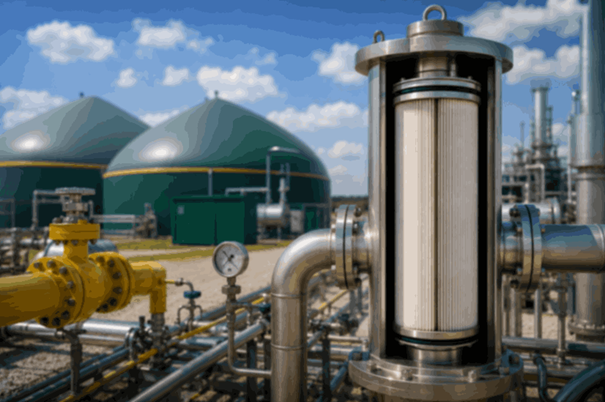
Filter Concept’s engineered solution for biogas pre-treatment is an ATEX Zone 1 / IECEx Coalescing Cartridge Filter Housing installed at the digester gas outlet — between the gas-water separator and the H₂S removal media vessel (iron oxide bed, activated carbon, biological scrubber). Every design element is matched to renewable gas plant operating reality.
ATEX Zone 1 / IECEx certified housing. SS 316L pressure housing certified to ATEX 2014/34/EU Group II Category 1G (or IECEx equivalent) for biogas hazardous-area service. Internal bonding and external earthing per IEC 60079-32-1. Documentation pack includes EC type-examination certificate, declaration of conformity, and full
installation/operation/maintenance manual for PESO inspection (India), HSE certification (UK), or OSHA PSM audit (U.S.).
Borosilicate microfibre coalescing element. Engineered glass-fibre coalescing media at 1–5 micron captures particulates and coalesces water aerosols into drainable liquid — removing both contamination types in a single stage. Auto-drain valve at the housing low point routes coalesced condensate to the plant’s liquid disposal system. Element life typically 6–12 months on properly operating biogas pre-treatment trains.
Pre-stage solids capture. Where biogas carries elevated particulate loading (digester carryover, agricultural feedstock variability), an upstream pre-stage with 25-micron polypropylene depth filter extends coalescing element life by 3–4×. FC-PDS™ specifies whether the pre-stage is needed based on actual gas analysis.
NACE MR0175 wetted compliance. All wetted materials including seals (FKM Viton for H₂S service), gaskets (PTFE), and internal components selected and certified per NACE MR0175 / ISO 15156 sour service requirements. This is the same materials discipline applied across oil & gas amine systems — brought to biogas service with documented certification.
Duplex configuration for continuous service. Two housings in parallel with flow-balanced changeover valve manifold. Element changeout on the offline housing while the online housing carries full flow. Zero plant downtime for filtration maintenance — essential for SATAT, RenovaBio, and EU RED III plants operating under offtake guarantee.
FC-PDS™ specification methodology. Element configuration and changeout interval are specified from your actual biogas composition (CH₄, CO₂, H₂S, water, siloxanes), digester flow rate, downstream conditioning architecture (engine, CHP, CBG upgrading, biomethane grid injection), and operating climate. Site-specific engineering produces sustained gas quality that protects every downstream asset in the chain.
Engineering Specifications at a Glance
| Parameter | Specification |
| Housing Material | SS 316L — NACE MR0175 / ISO 15156 sour service compliant |
| Coalescing Element | Borosilicate microfibre — 1 to 5 micron |
| Pre-Stage Element (Optional) | Polypropylene depth filter — 25 micron (where particulate loading is elevated) |
| Outlet Particulate | Less than 0.3 mg/Nms |
| Outlet Liquid Carryover | Less than 0.1 mg/Nms (engine-grade) |
| Hazardous Area Rating | ATEX 2014/34/EU Group II Category 1G · IECEx Zone 1 |
| Parameter | Specification |
| Static Discharge Protection | Internal bonding + external earthing per IEC 60079-32-1 |
| Flow Rate | 50 to 2,000 Nms/hr (biogas) |
| Operating Pressure | Up to 6 bar |
| Operating Temperature | Ambient to 60°C (gas service) |
| Seal Material | FKM (Viton) primary · PTFE secondary (H₂S + sour service rated) |
| Auto-Drain | Float-operated condensate drain for coalesced water/liquid |
| Service Model | Retrofit / New supply + FaaS (element supply on AMC) |
Global Standards & Regional Compliance Matrix
Biogas pre-treatment filtration sits at the intersection of hazardous-area certification, sour service materials compliance, and renewable energy programme documentation requirements. The FCPL ATEX Coalescing Cartridge Filter Housing is engineered to international baselines with regional certifications added per destination market:
| Region / Cluster | Applicable Standards & Regulations |
| International (Universal) | ATEX 2014/34/EU · IECEx · IEC 60079 (hazardous area equipment) · IEC 60079-32-1 (ESD) · ASME Section VIII Div. 1 · NACE MR0175 / ISO 15156 · ISO 14001 |
| North America | EPA RNG / RFS programmes · NFPA 820 (wastewater facility fire protection) · OSHA PSM · NEC Class I Division 1/2 · USDA-AMS organic carbon claims framework |
| Europe | EU Renewable Energy Directive III (RED III) · EN 16723-1/2 (biomethane grid injection) · PED 2014/68/EU · ATEX Directive 2014/34/EU · SEVESO III |
| Middle East & GCC | Emerging GCC renewable gas frameworks · GSO conformity · Saudi Aramco specifications (industrial biogas service) · Saudi MEIM renewable energy targets |
| Africa | South Africa SANEDI biogas programme · Kenya KEBS bioenergy standards · Tanzania BERA · Ethiopia biogas dissemination programme |
| Asia-Pacific & India | MNRE SATAT programme · PNGRB CBG standards · PESO Petroleum and Explosives Safety Organisation · IS 16087 (biogas utilisation) · CPCB biogas engine emission norms · |
| Region / Cluster | Applicable Standards & Regulations |
| PETRONAS Malaysia RNG · PT Pertamina Indonesia biogas · China GB biogas standards | |
| Latin America | Brazil RenovaBio programme · ANP biomethane specifications · Argentina renewable gas framework · Chile renewable gas pilot programmes |
Two frameworks deserve specific attention. ATEX 2014/34/EU and the parallel IECEx scheme provide the universal hazardous-area certification framework referenced by PESO, OSHA, HSE, and equivalent national authorities. EN 16723-1/2 sets the European biomethane grid injection specification that is increasingly used as a global benchmark even outside the EU — referenced by Indian PNGRB CBG standards and emerging RNG specifications in North America. The FCPL housing is engineered to satisfy both — making it qualifiable across the major renewable gas plant procurement environments worldwide.
The Bottom Line for Renewable Gas Plant Developers and Operators
Biogas pre-treatment filtration is the rare engineering decision in renewable energy plant operations where the equipment protection case, the regulatory case, and the offtake contract case all align in the same direction. The cost of getting it wrong cascades from gas engine warranty void through CBG upgrading membrane failure into pipeline rejection — each one independently capable of destroying plant economics. The cost of getting it right is a fraction of one avoided gas engine overhaul.
Filter Concept has been engineering hazardous-area gas filtration solutions for over twenty-three years — originally for upstream oil & gas amine and dehydration service, and over the last decade adapted to the rapidly growing biogas, CBG, and biomethane sector. Installations span major renewable gas clusters in 90+ countries: SATAT CBG plants across India under IOCL/BPCL/HPCL offtake, U.S. RNG facilities supplying interstate pipelines, EU biomethane plants under RED III, Brazilian RenovaBio-certified biogas operations, and emerging biogas capacity across Africa and Southeast Asia. The ATEX Coalescing Cartridge Filter Housing for biogas pre-treatment is one of our most engineered, most repeated installations — because biogas chemistry is universally aggressive, but the discipline of engineering ATEX Zone 1 certified housings with NACE-compliant materials and coalescing-grade media is rare in the global filtration market.
If your gas engine overhaul interval has slipped below design, if your CBG upgrading membrane replacement frequency has exceeded design, or if your biomethane grid injection has experienced rejection events — your biogas pre-treatment filtration is the first place to look. We are happy to review your biogas composition and offer a sized FC-PDS™ specification at no obligation, anywhere in the world.
TALK TO OUR RENEWABLE GAS FILTRATION TEAM
Send us your biogas composition (CH₄, CO₂, H₂S, water content, siloxane levels), digester flow rate, downstream conditioning architecture (engine / CHP / CBG / biomethane), and operating jurisdiction. We will return a sized FC-PDS™ specification with ATEX certification documentation, coalescing housing P&ID, and an indicative annual gas engine / membrane life extension projection — within 5 working days.
Service available across 90+ countries.
ABOUT THE AUTHOR
Mehul J Panchal is the Founder of Filter Concept Group, a global industrial filtration manufacturer serving 5,000+ customers across 90+ countries with 23+ years of engineering depth. The company’s product portfolio spans 50+ industries including oil & gas, LNG, petrochemicals, power, water treatment, pharmaceuticals, and food processing. Mehul writes on filtration economics, process engineering, and the practical realities of running filtration systems at industrial scale.