

By Mehul J Panchal, Founder, Filter Concept Group | 9-minute read | Biotechnology Filtration Series
Biotechnology manufacturing operates at the intersection of three of the most demanding regulatory frameworks in industry: USFDA cGMP for biologics, EMA biologics requirements, EU GMP Annex 1 (2022 revision) for sterile manufacturing, and — increasingly
— ICH Q11 development and manufacture of drug substances. Across this regulatory envelope, the most consequential utility is the prepared bioreactor feed: the media, buffer, and process water streams that enter mammalian cell culture, microbial fermentation, and downstream purification operations.
From Roche’s biologics campuses to Lonza CDMO operations, from Indian biosimilar manufacturers (Biocon, Dr Reddy’s, Zydus) to emerging GCC biotechnology programmes (KAIMRC, Lifera Saudi Arabia), every biologics plant depends on sterile-grade filtration at multiple points in the bioreactor feed path: media preparation, buffer preparation, fermentation media supply, downstream chromatography buffer supply, and cell culture media supplementation. The engineering reality is that 0.2-micron absolute sterilising-grade filtration in ASME BPE-compliant housings is now a fundamental requirement — not an enhancement. This article explains why a properly engineered Sterile-Grade Cartridge Filter Housing has become the global engineering standard for biotech bioreactor feed and buffer preparation, and why the cost of getting it wrong is measured in million-dollar batch failures rather than equipment cost.
The Hidden Stakes of Biotech Filtration Failure
Three numbers explain why biotech bioreactor feed filtration deserves the same engineering attention as the bioreactor itself.
Stake one: contaminated batch loss. A single contamination event in a 10,000-litre mammalian cell culture bioreactor producing monoclonal antibodies typically destroys USD 500,000 to 10,000,000 in in-process value, depending on the product class and process stage. For high-value biologics (oncology mAbs, gene therapies, advanced cell therapies), single-batch losses can exceed USD 50 million. The root cause analysis on contamination events repeatedly identifies feed-stream filtration gaps as the proximate failure mode.
Stake two: validation re-qualification. When a sterile filter fails integrity testing or a contamination event occurs, the affected manufacturing train requires complete re-qualification: cleaning validation re-execution, sterilisation cycle requalification, environmental monitoring trend re-establishment. This consumes 4–8 weeks of plant downtime at a cost of USD 2–10 million depending on plant capacity, plus the regulatory documentation cascade that follows.
Stake three: regulatory consequence under Annex 1 (2022). The 2022 revision of EU GMP Annex 1 has tightened sterile manufacturing utility documentation requirements substantially. Pre-filter validation gaps, sterile filter integrity test documentation, and bioreactor feed filtration architecture are now examined with notably greater scrutiny. USFDA cGMP inspections have followed similar tightening. For biologics plants supplying regulated markets, a documentation gap on bioreactor feed filtration can suspend product release for the affected campaign.
Why Generic Filtration Fails on Biotech Service
Biotech bioreactor feed service combines four constraints that defeat any conventional industrial cartridge filtration:
- Non-ASME-BPE Bioreactor feed lines and buffer preparation systems run under continuous CIP/SIP cycles. ASME BPE codifies the geometric requirements: Ra ≤ 0.5 µm product-contact surfaces, full drainability, no dead legs greater than 2D in length, orbital-welded joints, sanitary tri-clamp connections.Generic industrial cartridge housings fail every one of these criteria by design — making them non-qualifiable for biotech service regardless of the cartridge inside them.
- Non-sterilising-grade cartridge Sterile-grade filtration requires 0.2-micron absolute polyethersulfone (PES) or polyvinylidene fluoride (PVDF) membrane cartridges with documented bacterial retention efficiency per ASTM F838 (≥ 1×10⁷ CFU/cm² challenge). Generic polypropylene depth filters do not provide bacterial retention regardless of nominal rating. The engineered answer is membrane-class media with integrity test capability and lot-level certification.
- Inability to integrity-test in USFDA and EU GMP Annex 1 mandate post-use integrity testing of sterilising-grade filters — typically bubble-point or pressure-hold test. Cartridge housings must support in-place integrity testing without disassembly. Generic housings without integrity test ports are operationally non-compliant in a sterile manufacturing context.
- Extractables and leachables from sub-pharmacopoeial materials. Biotech process streams contact filter materials for hours to days. Extractables and leachables from non-pharmaceutical-grade materials enter the product. EU GMP Annex 1 and FDA Guidance for Industry on extractables/leachables for parenteral products both require qualified materials with documented extractables studies. Generic cartridges without USP <88> Class VI, USP <87>/<88> cytotoxicity, and full extractables documentation cannot be used in biotech sterile service.
Each of these failures independently disqualifies a filtration installation from biotech use. Their combined effect is what produces the recurring deficiency findings cited in USFDA, EMA, and WHO PQ inspections of biopharmaceutical manufacturers globally.
The FCPL Solution: Sterile-Grade Cartridge Filter Housing for Bioreactor Feed and Buffer Preparation
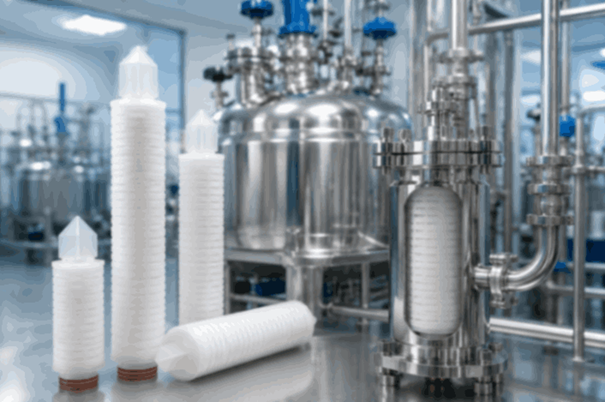
Filter Concept’s engineered solution for industrial filter and biotech bioreactor feed and buffer preparation is a Sterile-Grade Cartridge Filter Housing installed at multiple points in the process train: media preparation polish, sterile media supply to bioreactor, buffer preparation polish, sterile buffer supply to downstream operations, and chromatography column inlet. Every design element is matched to global biotech regulatory and engineering reality.
ASME BPE-compliant SS 316L geometry. Internal surface electropolished to Ra ≤ 0.4 µm — below the ASME BPE threshold. Fully drainable design with no dead legs. Orbital-welded internal joints. Sanitary tri-clamp connections (0.5” to 3”) matched to biotech process pipework standards. SIP-compatible to 135°C without seal degradation.
0.2-micron absolute sterilising-grade PES or PVDF cartridge. Membrane-class media with documented bacterial retention efficiency per ASTM F838 (≥ 1×10⁷ CFU/cm² Brevundimonas diminuta challenge). USP <88> Class VI biocompatibility, USP <87>/<88> cytotoxicity tested,full extractables study documentation. Available in PES (general aqueous service) or PVDF (low-binding, recommended for high-value protein products).
In-place integrity testing capability. Dedicated integrity test port supports automated bubble-point or pressure-hold integrity testing without disassembly. Documentation captured by the plant’s laboratory information management system supports the Annex 1 / FDA cGMP integrity test record requirement. Pre-use and post-use testing protocols included in the documentation pack.
Complete validation documentation pack. Each housing ships with documentation designed for direct insertion into the validation file: material certificate to EN 10204-3.1 with full traceability, surface finish certificate, extractables study report (USP, EMA, and FDA-aligned protocols), endotoxin certification, biocompatibility documentation, and DQ/IQ/OQ/PQ template documentation. This is the difference between buying a filter and buying a regulated biotech utility component.
Single-use compatibility option. For high-value biologics and ATMP (Advanced Therapy Medicinal Products) operations transitioning to single-use technology, FCPL supplies the housing with gamma-irradiated single-use cartridge options pre-assembled to the housing. The plant retains the housing infrastructure while gaining single-use sterile boundary management.
FC-PDS™ specification methodology. Cartridge grade, micron rating, area, and changeout frequency are specified from your actual process parameters — bioreactor volume, buffer flow demand, media composition, product class, and regulatory destination market. Site-specific engineering produces sterile assurance level that satisfies the most stringent global biotech regulators.
Engineering Specifications at a Glance
| Parameter | Specification |
| Housing Material | SS 316L — electropolished to Ra ≤ 0.4 µm (ASME BPE compliant) |
| Filter Media | 0.2 micron absolute PES or PVDF sterilising-grade cartridge |
| Bacterial Retention | ≥ 1×10⁷ CFU/cm² B. diminuta challenge per ASTM F838 |
| Connections | Sanitary tri-clamp 0.5” to 3” (ASME BPE standard) |
| Internal Geometry | Fully drainable — no dead legs > 2D per ASME BPE |
| Flow Rate | 100 to 10,000 LPH per housing |
| Operating Temperature | Ambient to 80°C continuous; SIP cycle to 135°C |
| Parameter | Specification |
| CIP / SIP Compatibility | NaOH 1M, peracetic acid 0.5%, clean steam 135°C |
| Integrity Test | Bubble point or pressure hold per ASTM F838 (in-place capable) |
| Biocompatibility | USP <88> Class VI · USP <87>/<88> cytotoxicity · Endotoxin certified |
| Documentation | EN 10204-3.1 · Extractables study · Endotoxin cert · DQ/IQ/OQ/PQ templates |
| Service Model | Sustainable Filters + FaaS (validated element supply with lot traceability) |
Global Standards & Regional Compliance Matrix
Biotech bioreactor feed and buffer preparation filtration sits at the intersection of biologics manufacturing GMP, ASME BPE equipment design, and pharmacopoeial water and material standards. The FCPL Sterile-Grade Cartridge Filter Housing is engineered to international baselines with regional certifications added per destination market:
| Region / Cluster | Applicable Standards & Regulations |
| International (Universal) | ASME BPE (Bioprocessing Equipment) · ASTM F838 (bacterial retention) · USP <87>/<88> (biocompatibility) · USP <88> Class VI · ICH Q5A/Q7/Q11 · PIC/S GMP · ISO 14644 (cleanrooms) |
| North America | USFDA 21 CFR 600–680 (biologics) · USFDA cGMP 21 CFR 210/211 · FDA Guidance for Industry Sterile Drug Products · USFDA Process Validation Guidance |
| Europe | EU GMP Annex 1 (2022 revision — sterile medicinal products) · EU GMP Annex 2 (biological substances) · EMA biosimilar guidelines · PED 2014/68/EU · EMA Q&A on Annex 1 |
| Middle East & GCC | Saudi FDA (SFDA) biologics · UAE Ministry of Health · GHC pharmacopoeia · WHO TRS 970 Annex 2 · Saudi Lifera biomanufacturing programme |
| Africa | South Africa SAHPRA biologics · Egypt EDA · Nigeria NAFDAC · WHO PQ scheme for African biosimilar supply |
| Asia-Pacific & India | CDSCO Schedule M (biotechnology amendment) · Indian Pharmacopoeia (biotechnological products) · ICMR-NIB biologics standards · Japan PMDA biologics · China NMPA biologics · South Korea MFDS · PIC/S regional members |
| Region / Cluster | Applicable Standards & Regulations |
| Latin America | Brazil ANVISA biologics · Mexico COFEPRIS · Argentina ANMAT · Pacific Alliance biosimilar pathway |
Two frameworks deserve specific attention. EU GMP Annex 1 (2022 revision) has become the de facto global benchmark for sterile manufacturing utility design — referenced by USFDA in inspection observations even outside EU jurisdiction. ASME BPE is the universal global engineering standard for biotech process equipment design, referenced by every major biologics manufacturer regardless of jurisdiction. The FCPL housing satisfies both — making it qualifiable across global biotechnology procurement environments including export-grade biologics manufacturing in India, biosimilar operations in GCC and Latin America, and CDMO supply chains in Europe and North America.
The Bottom Line for Biotech Operations Heads, QA Leadership, and Validation Teams
Biotech bioreactor feed filtration is one of the rare engineering decisions in biologics manufacturing where the regulatory case, the product quality case, the patient safety case, and the commercial case all align in the same direction. The cost of getting it wrong is not a maintenance line item — it is contaminated batch loss measured in millions of dollars, validation re-qualification cascades, GMP audit consequence, and the kind of operational disruption that affects regulatory inspection history for years. The cost of getting it right is a fraction of any one of those exposures.
Filter Concept has been engineering biotech and biopharmaceutical filtration solutions for the global sector for over twenty-three years, with installations across mammalian cell culture, microbial fermentation, vaccine manufacturing, biosimilar production, and CDMO operations in 90+ countries. Customers include Indian biosimilar and biologics manufacturers expanding into U.S. and EU markets, GCC and African biotechnology programmes, Southeast Asian CDMO operations, and emerging biomanufacturing capacity across Latin America. The Sterile-Grade Cartridge Filter Housing for bioreactor feed and buffer preparation is one of our most engineered, most validated, most documentation-intensive installations — because biotech regulatory requirements are now globally harmonised under PIC/S and ICH frameworks, but the discipline of engineering ASME BPE-compliant housings with full extractables, endotoxin, and biocompatibility documentation is rare in the global filtration market.
If your last USFDA, EMA, WHO PQ, or CDSCO inspection raised any flags on bioreactor feed filtration documentation, if your sterile filter integrity test pass rate has trended downward, or if your batch contamination root-cause analysis has implicated upstream filtration — your bioreactor feed and buffer preparation filtration is the first place to look. We are happy to review your process specification and offer a sized FC-PDS™ specification at no obligation, anywhere in the world.
TALK TO OUR BIOTECH FILTRATION TEAM
Send us your bioreactor specification (volume, product class — mAb / vaccine / biosimilar / ATMP), buffer preparation flow demand, media composition, and regulatory destination markets. We will return a sized FC-PDS™ specification, ASME BPE-compliant housing P&ID, complete validation documentation pack (DQ/IQ/OQ/PQ templates, extractables study, biocompatibility certification), and Annex 1 alignment review — within 5 working days. Service available across 90+ countries.
ABOUT THE AUTHOR
Mehul J Panchal is the Founder of Filter Concept Group, a global industrial filtration manufacturer serving 5,000+ customers across 90+ countries with 23+ years of engineering depth. The company’s product portfolio spans 50+ industries including oil & gas, LNG, petrochemicals, power, water treatment, pharmaceuticals, and food processing. Mehul writes on filtration economics, process engineering, and the practical realities of running filtration systems at industrial scale.