
By Mehul J Panchal, Founder, Filter Concept Group | 9-minute read | Power Generation Filtration Series
The steam cycle is the engineering heart of every thermal, combined cycle, and nuclear power plant on earth. Across NTPC, Adani Power, JSW Energy, Tata Power, ACWA Power, ENGIE, RWE, Duke Energy, Southern Company, KEPCO, TEPCO — every operator of large steam-cycle generation runs a continuous battle against iron oxide. Condensate returning from the steam turbine condenser through the LP and HP feed water heater train carries iron oxide (Fe₃O₄ magnetite, Fe₂O₃ hematite) and trace copper corrosion products at concentrations of 5 to 50 ppb. These metal oxides are the single greatest threat to mixed-bed (MB) condensate polishing resin beds, to boiler tube cleanliness, and ultimately to the asset availability that defines combined cycle and supercritical plant economics.
What separates power plants with sustained boiler tube reliability from those with chronic deposition, hideout corrosion, and forced outage cascades is the engineering of the condensate polishing pre-filtration stage — the multi-bag filter housing installed immediately upstream of the MB polisher to capture iron oxide before it reaches the resin. Most plants have a polisher. Few have one that is properly protected. Inadequate pre-filtration shortens MB resin life from design 5–7 years to 2–3 years, increases regeneration chemical cost by 30–60%, and in the worst case — sends iron oxide directly to the boiler where it causes the recurring tube failures that drive thermal plant operating budgets globally. This article explains why a properly engineered IBR-Stamped Multi-Bag Filter Housing has become the universal global standard for condensate polishing pre-filtration.
The Hidden Economics of Condensate Pre-Filtration Failure
Three numbers explain why condensate polishing pre-filtration deserves continuous engineering attention rather than routine lifecycle planning.
Driver one: MB resin replacement frequency and capacity loss. Mixed-bed condensate polishing resin (anion and cation in the same vessel) is one of the most expensive consumables in the power plant operating budget at USD 100,000 to 350,000 per vessel. Without proper iron oxide pre-filtration, resin fouls within 2–3 years rather than design 5–7 years — destroying USD 50,000 to 175,000 per year in deferred resin replacement value across the asset lifecycle. Regeneration chemical consumption (HCl, NaOH) rises 30–60% as fouled resin requires more aggressive cleaning, adding USD 100,000 to 300,000 annually.
Driver two: boiler tube failure cascade. Iron oxide that escapes the polishing system deposits on boiler tube internal surfaces, where it acts as a corrosion-promotion site (under-deposit corrosion, hideout boiling, caustic gouging). A single boiler tube failure event costs USD 200,000 to 500,000 in repair plus 7–14 days of generation outage — USD 1.5 to 3 million in lost generation revenue at a 500 MW unit. Across thermal generation fleets globally, iron oxide-driven tube failures account for a disproportionate share of forced outage events, with documented root cause in many cases tracing back to inadequate condensate pre-filtration.
Driver three: combined cycle bottoming cycle availability. In combined cycle plants, condensate pre-filtration failure cascades through the HRSG (Heat Recovery Steam Generator) where the consequences are amplified by the smaller steam volume and tighter tolerance for chemistry excursion. CC plants typically experience higher per-MW impact from condensate excursions than conventional thermal units. The pre-filtration that prevents these excursions is among the lowest-cost protection elements in the plant capex stack.
Why Generic Bag Filtration Fails on Condensate Polishing Service
Condensate polishing pre-filtration service combines three constraints that defeat any conventional industrial bag filtration:
- Iron oxide particle size below standard bag retention. Iron oxide corrosion products in condensate are typically in the 1–5 micron range — below the retention envelope of standard 25-micron polypropylene felt Without engineered media selection, generic bags pass the iron oxide they are supposed to capture. The engineered answer is glass fibre bag media at 5 to 10 micron absolute rating with documented retention efficiency for sub-10-micron iron oxide — the specification class that condensate polishing service actually requires.
- IBR / ASME Section I pressure equipment compliance. Condensate polishing systems sit in the steam cycle pressure envelope at 40–80 bar operating pressure. In India, condensate polishing equipment falls under Indian Boiler Regulations (IBR) statutory inspection. In the U.S., ASME Section I and ASME Section VIII Div. 1 govern. In Europe, PED 2014/68/EU applies. The engineered answer is full IBR/ASME/PED stamping with documented hydrostatic test certification — a regulatory baseline that generic industrial bag housings do not meet.
- Continuous service with multi-bag changeout capability. Condensate polishing systems run continuously through every operating campaign — typically 8,760 hours per year on baseload units. Single-housing configurations forcing offline bag changeout are operationally unworkable. The engineered answer is multi-bag housing in 4, 8, 16, or 24-bag configurations with individual bag isolation — sized to handle full condensate flow with N+1 redundancy.
Each of these failures independently degrades MB polisher service. Their combined effect is what produces the chronic resin replacement cycles and tube failure events that consume power plant maintenance budgets globally.
The FCPL Solution: IBR-Stamped Multi-Bag Filter Housing for Condensate Polishing Pre-Filtration
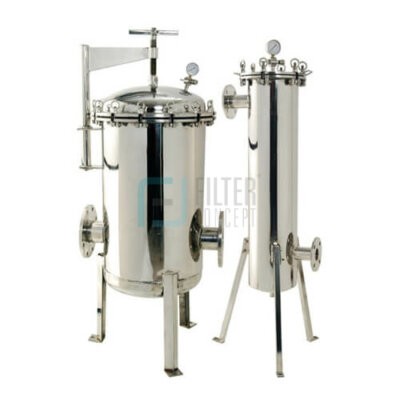
Filter Concept’s engineered solution for power plant condensate polishing pre-filtration is a Multi-Bag Filter Housing installed on the condensate return line, downstream of the deaerator drain and feed heater drain cascades, immediately upstream of the MB polishing vessel. Every design element is matched to power plant operational and regulatory reality.
Glass fibre bag media for iron oxide capture. Glass fibre bag media at 5 to 10 micron absolute rating captures sub-10-micron iron oxide and copper corrosion products with documented efficiency. Surface-treated outer layer prevents fibre migration into the downstream MB polisher. FC-PDS™ selects media grade from actual condensate iron and copper analysis — with provision for staged media (10 micron pre-filter + 5 micron polisher) where condensate corrosion product loading is elevated.
IBR / ASME Section I / PED stamped housing. Multi-bag housing fully stamped to IBR (Indian Boiler Regulations) for Indian power plant statutory compliance. ASME Section I and Section VIII Div. 1 compliance for North American installations. PED 2014/68/EU for European jurisdictions. Pressure rating to 40 bar covers the full operating envelope of condensate return line service. Hydrostatic test certification with documented inspection by competent authority.
Multi-bag configuration. 4, 8, 16, or 24-bag housings sized to actual condensate flow with N+1 redundancy. Individual bags isolate for changeout under PPE-protected hot-service protocols while the housing carries flow — essential for continuous baseload operation. Quick-release davit closure for rapid bag changeout. Differential pressure indicators per bank for changeout timing optimisation.
SS 316L wetted construction. Full SS 316L wetted construction with documented compatibility for condensate at 90–130°C. Optional EN 10204-3.1/3.2 material certification for European jurisdictions and export-grade documentation. Internal welds passivated for corrosion resistance and reduced iron release from the housing itself.
FaaS service model with cleanliness audit. Annual service includes bag inventory management, changeout scheduling aligned to plant boiler chemistry monitoring, differential pressure data logging for plant reliability KPIs, and Sustainable Filters bag recovery for circular economy reporting. The plant receives a documented preventive maintenance log supporting CEA, NERC, EU IED, and equivalent regulatory documentation requirements.
FC-PDS™ specification methodology. Bag count, micron rating, and media type are specified from your actual condensate analysis (iron, copper, silica, dissolved oxygen), peak and average flow demand, downstream MB polisher specification, and statutory inspection jurisdiction. Site-specific engineering produces the sustained iron oxide control that MB resin protection requires.
Engineering Specifications at a Glance
| Parameter | Specification |
| Housing Material | SS 316L (condensate service standard) |
| Filter Media (Standard) | Glass fibre bag media — 5 to 10 micron absolute |
| Iron Oxide Capture Efficiency | Greater than 95% on sub-10-micron Fe₃O₄/Fe₂O₃ |
| Configuration | Multi-bag (4, 8, 16, 24 bag) sized to condensate flow demand |
| Flow Rate | 50 to 1,500 ms/hr (matched to plant condensate flow) |
| Operating Pressure | Up to 40 bar (condensate return line) |
| Operating Temperature | Up to 130°C continuous (post-deaerator condensate |
| Parameter | Specification |
| service) | |
| Outlet Iron Content | Less than 5 ppb (MB resin protection threshold) |
| Outlet Copper Content | Less than 3 ppb |
| Pressure Vessel Code | IBR (India) · ASME Section I & VIII Div. 1 (US) · PED 2014/68/EU (EU) |
| Closure | Quick-release davit lid for rapid bag changeout |
| Service Model | FaaS + Sustainable Filters (lifecycle bag inventory management) |
Global Standards & Regional Compliance Matrix
Power plant condensate polishing pre-filtration sits at the intersection of statutory boiler regulation, water chemistry guidelines, and grid reliability frameworks. The FCPL Multi-Bag Filter Housing is engineered to international baselines with regional certifications added per destination market:
| Region / Cluster | Applicable Standards & Regulations |
| International (Universal) | ASME Section I (Power Boilers) · ASME Section VIII Div. 1 · ASME PTC 12.2 · IAPWS guidelines (water chemistry) · EPRI Cycle Chemistry Guidelines |
| North America | ASME BPVC Sections I & VIII · EPRI Condensate Polishing Guidelines · NERC reliability standards · EPA Steam Electric Effluent Guidelines |
| Europe | PED 2014/68/EU · EN 12952 (water-tube boilers) · EN 12953 (shell boilers) · EU Industrial Emissions Directive · VGB guidelines |
| Middle East & GCC | Saudi Aramco SAES-K-001 (utility water) · ADWEA/DEWA technical specifications · KAHRAMAA standards · SASO conformity |
| Africa | Eskom NRS standards (South Africa) · SABS · EPRA Kenya · NESREA Nigeria |
| Asia-Pacific & India | IBR (Indian Boiler Regulations — statutory) · IS 1554 (BFW Quality Standards) · CEA Thermal Power Plant Performance Standards · PESO certification · PETRONAS / TNB engineering specs (SE Asia) · Japan JIS B 8201 · China DL/T water chemistry standards |
| Region / Cluster | Applicable Standards & Regulations |
| Latin America | Brazil ABNT NBR power plant standards · ANEEL specifications · Pemex CFE specifications (Mexico) |
Three frameworks deserve attention. IBR (Indian Boiler Regulations) imposes statutory periodic inspection on all boiler-adjacent pressure equipment in India — making IBR stamping non-negotiable for the Indian power market. EPRI Cycle Chemistry Guidelines have emerged as the de facto global engineering benchmark for steam cycle water chemistry, referenced by power plant chemists across jurisdictions. IAPWS water chemistry guidelines provide the universal scientific reference for boiler water and condensate chemistry. The FCPL housing is engineered to satisfy all three — making it qualifiable across global power plant procurement environments.
The Bottom Line for Power Plant Chemists, Utilities Engineers, and Asset Managers
Condensate polishing pre-filtration is the rare engineering decision where the resin life case, the boiler tube reliability case, and the regulatory compliance case all align in the same direction. The cost of getting it wrong cascades from premature MB resin replacement through chemistry excursion into boiler tube failure events — each one independently capable of consuming multi-year filtration budgets. The cost of getting it right is a fraction of one avoided resin replacement event.
Filter Concept has been engineering power plant filtration solutions for the global generation sector for over twenty-three years, with installations across thermal, combined cycle, supercritical, and nuclear secondary cycle applications in 90+ countries. Customers include NTPC, Adani Power, Tata Power, JSW Energy (India), ACWA Power (GCC), Saudi Aramco co-generation, and EPC contractors serving global power capacity expansion. The Multi-Bag Filter Housing for condensate polishing pre-filtration is one of our most engineered installations
— because IBR / ASME / PED requirements are non-negotiable, but the discipline of engineering multi-bag housings with glass fibre media at documented sub-10-micron iron oxide capture efficiency and statutory pressure stamping is rare in the global filtration market.
If your MB resin replacement frequency has shortened, if your condensate polishing regeneration chemical consumption has crept upward, or if your last boiler tube inspection raised any flags on iron deposition — your condensate polishing pre-filtration is the first place to look. We are happy to review your condensate analysis and offer a sized FC-PDS™ specification at no obligation, anywhere in the world.
TALK TO OUR POWER PLANT FILTRATION TEAM
Send us your condensate analysis (iron, copper, silica, dissolved oxygen, flow demand), MB polisher specification, statutory inspection jurisdiction (IBR/ASME/PED), and current resin replacement history. We will return a sized FC-PDS™ specification with media selection rationale, multi-bag housing P&ID, statutory stamping documentation, and an indicative annual resin life and boiler reliability improvement projection — within 5 working days. Service available across 90+ countries.
ABOUT THE AUTHOR
Mehul J Panchal is the Founder of Filter Concept Group, a global industrial filtration manufacturer serving 5,000+ customers across 90+ countries with 23+ years of engineering depth. The company’s product portfolio spans 50+ industries including oil & gas, LNG, petrochemicals, power, water treatment, pharmaceuticals, and food processing. Mehul writes on filtration economics, process engineering, and the practical realities of running filtration systems at industrial scale.