

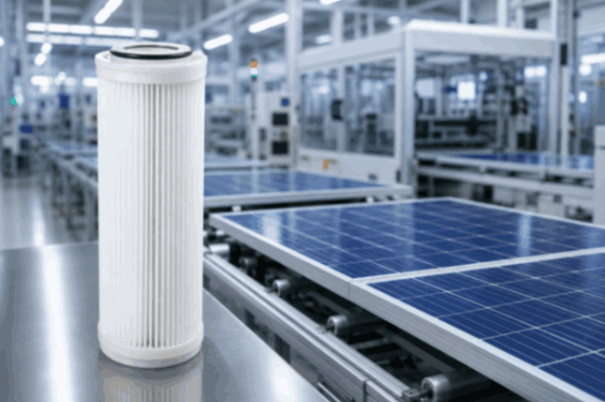
By Mehul J Panchal, Founder, Filter Concept Group | 9-minute read | Solar PV Manufacturing
The global solar PV manufacturing industry is undergoing the largest production capacity expansion in industrial history. India’s Production-Linked Incentive (PLI) Scheme for solar manufacturing has committed USD 3+ billion to support 65+ GW of new cell and module capacity by 2030, with Adani Solar, Reliance New Energy, Vikram Solar, Waaree, Tata Power Solar, and Premier Energies scaling to GW-class production. China continues to dominate global capacity at 500+ GW, with the U.S. Inflation Reduction Act driving 30+ GW of domestic capacity at First Solar, Hanwha Q Cells, and Meyer Burger. Europe (Meyer Burger, Enel Green Power), Southeast Asia (LONGi, JinkoSolar, Trina Solar manufacturing across Vietnam, Malaysia, Thailand), and emerging GCC capacity (Saudi Arabia’s NEOM, UAE’s Masdar) round out a USD 200+ billion global manufacturing build-out.
What every solar cell and module factory worldwide shares is the same critical utility: Ultra-Pure Water for wafer cleaning, texturing, anti-reflective coating (ARC), and module assembly. UPW quality directly determines wafer surface defect density, cell efficiency, and module manufacturing yield. SEMI F57 specifies resistivity >18 MΩ·cm and particle count <100 particles/mL at 0.05 micron — the same UPW class semiconductor fabs require, applied to solar manufacturing scale. The engineering interface between this specification and operational reality is a 0.05 to 0.1 micron absolute cartridge filter in an electropolished SS 316L housing, installed at the point-of-use upstream of the wafer cleaning station or texturing tank. This article explains why getting that filter right is now one of the highest-leverage capital decisions in global solar manufacturing.
The Hidden Economics of Solar Manufacturing UPW Failure
Three numbers explain why solar PV manufacturing UPW filtration deserves first-rank capital priority alongside the texturing tools and PECVD equipment themselves.
Driver one: cell efficiency loss from wafer surface defects. Each sub-50-nanometre particle that reaches a silicon wafer during cleaning, texturing, or rinsing creates a potential surface defect that propagates through the entire cell fabrication process. Documented cell efficiency loss from inadequate UPW is 0.3 to 1.5 percentage points absolute on commercial-grade mono-PERC and TOPCon cells — against typical efficiency of 22–24%. For a 5 GW annual module factory producing 12.5 million cells per day, a 0.5 percentage point efficiency loss represents USD 75–125 million per year in lost revenue — a number that converts UPW filtration from a maintenance item into a strategic capability.
Driver two: wafer cleaning yield and cell scrap. Wafer defects severe enough to fail post-cleaning visual inspection result in cell scrap at USD 8,000 to 60,000 per affected lot, depending on cell technology and silver content. At commercial-scale factories producing 1,000+ wafers per minute, cumulative scrap rates from UPW excursions compound into multi-million-dollar annual losses. Adequate UPW filtration converts wafer cleaning from a yield-limiting bottleneck into a sustained production capability.
Driver three: PLI compliance and capacity ramp acceleration. Indian PLI commitments require solar manufacturers to achieve declared production capacity within strict timelines, with documented technology and yield metrics. UPW filtration excursions that delay capacity ramp or fail to meet yield specifications threaten PLI compliance — with documented consequences including incentive clawback. The filtration investment that secures PLI compliance is among the most strategically defensive capital commitments in the entire solar manufacturing capex stack.
Why Generic Filtration Fails on Solar Manufacturing UPW Service
Solar manufacturing UPW service combines three constraints that defeat any conventional industrial cartridge filtration:
- Extractable contamination degrading UPW resistivity. Generic polypropylene cartridges leach trace compounds that degrade UPW resistivity below the 18 MΩ·cm SEMI F57 threshold within hours of The engineered answer is ultra-clean PP or PES media with documented sub-ppb extractables — the same manufacturing discipline applied to semiconductor fab UPW, scaled to solar manufacturing throughput. Each cartridge lot ships with extractables certification and electrical conductivity verification.
- Non-electropolished surface Standard SS 316L cartridge housings with mill finish (Ra 0.8–1.6 µm) shed metal particles, leach trace iron, and harbour biofilm that contaminate UPW. Solar wafer cleaning sensitivity to trace metal contamination is high — iron, copper, or sodium deposition on wafer surfaces creates recombination centres that reduce minority carrier lifetime and cell efficiency. The engineered answer is electropolished internal surfaces at Ra ≤ 0.4 µm with passivated welds — the SEMI F78 specification class adapted to solar manufacturing economics.
- Sub-100-nm absolute retention requirements. Generic 0.2-micron nominal cartridges pass particles in the 50–100 nm range that are the actual yield-determining contaminants in solar wafer The engineered answer is 0.05 to
0.1 micron absolute-rated media with documented retention efficiency per ASTM F838-equivalent particle challenge testing. Each lot ships with integrity test capability for in-place verification.
Each of these failures independently degrades solar cell yield. Their combined effect is what produces the UPW system excursions that constrain capacity ramp at solar manufacturing facilities globally.
The FCPL Solution: Electropolished Cartridge Filter Housing for Solar PV Manufacturing UPW
Filter Concept’s engineered solution for solar PV manufacturing UPW is a Cartridge Filter Housing installed at the point-of-use upstream of the wafer cleaning station, texturing tank, ARC coating system, and module assembly clean lines. Every design element is matched to SEMI F57 and equivalent solar industry requirements.
Electropolished SS 316L housing. Internal surface electropolished to Ra ≤ 0.4 µm — the SEMI F78 specification class for UPW service. Fully drainable design with no dead legs. Sanitary tri-clamp connections matched to solar factory UPW system interfaces. Internal welds passivated and orbital-welded for contamination-free wetted geometry. SS 316L base metal
with optional electropolishing to Ra ≤ 0.25 µm for advanced TOPCon and HJT cell manufacturing where contamination sensitivity is elevated.
0.05 to 0.1 micron absolute ultra-clean cartridge. Ultra-clean polypropylene or polyethersulfone media with documented sub-ppb extractables. Absolute retention rated and integrity-testable. Each lot ships with particle retention efficiency test, extractables certification, and electrical conductivity verification — the documentation pack that solar factory UPW qualification protocols require for PLI compliance audits.
Resistivity-protective design. All wetted materials selected and processed to maintain UPW resistivity ≥ 18 MΩ·cm at the housing outlet. No leachable metals (Fe, Cu, Na, K verified below sub-ppb threshold), no organic extractables that contribute to TOC excursion. The housing functions as a contamination-protective component within the broader UPW system, not a contamination source that the downstream MB polisher must compensate for.
PLI documentation and EPC integration. Each housing ships with documentation designed for direct insertion into PLI compliance files: material certificate (EN 10204-3.1), surface finish certification, extractables study report, particle retention test data, and electrical conductivity verification. Designed for EPC integration with solar factory commissioning timelines (Larsen & Toubro, Tata Projects, ENGIE, Bechtel solar EPC partners). FCPL participates in factory commissioning teams during UPW system handover and validation.
Sized for GW-class manufacturing throughput. Single housings handle 0.5 to 50 ms/hr of UPW; multi-housing skids for GW-class factories with parallel manufacturing lines. FC-PDS™ sizes element count and changeout protocol from your actual UPW system architecture, wafer cleaning throughput, and target cell efficiency specification. Site-specific engineering produces the sustained sub-100-nm particle control that advanced cell technology yield requires.
FC-PDS™ specification methodology. Element grade and changeout frequency are specified from your actual UPW system architecture, mixed-bed resin condition, wafer cleaning chemistry (KOH/NaOH texturing, HF/HNO₃ etching, IPA drying), and cell technology platform (mono-PERC, TOPCon, HJT, perovskite tandem). Site-specific engineering produces the sustained UPW quality that GW-class solar manufacturing economics require.
Engineering Specifications at a Glance
| Parameter | Specification |
| Housing Material | SS 316L — electropolished to Ra ≤ 0.4 µm (SEMI F78 grade) |
| Filter Media | Ultra-clean PP or PES cartridge — 0.05 to 0.1 micron absolute |
| Retention Efficiency | 100% at 0.1 micron · 99.99% at 0.05 micron |
| Parameter | Specification |
| Extractables | Sub-ppb total — certified by lot |
| Resistivity Protection | Maintains UPW ≥ 18 MΩ·cm at outlet |
| Flow Rate | 0.5 to 50 ms/hr per housing (multi-housing skids for GW-class factories) |
| Operating Temperature | Ambient (UPW typical 20–25°C) |
| Operating Pressure | Up to 10 bar |
| Connections | Sanitary tri-clamp or orbital-welded compatible |
| Element Changeout | Weekly or by resistivity drop / DP indicator |
| Documentation | SEMI F57/F78 conformance · Particle retention test · Extractables · PLI compliance pack |
| Service Model | Sustainable Filters + FaaS (UPW-grade element supply with PLI documentation) |
Global Standards & Regional Compliance Matrix
Solar PV manufacturing UPW filtration sits at the intersection of semiconductor industry quality standards (applied to solar manufacturing scale), solar module performance certification, and
— increasingly — production-linked incentive scheme documentation. The FCPL Electropolished Cartridge Filter Housing is engineered to international baselines with regional certifications added per destination market:
| Region / Cluster | Applicable Standards & Regulations |
| International (Universal) | SEMI F57 (UPW Specifications) · SEMI F78 (UPW System Design) · SEMI F63 (UPW for IC Manufacturing — reference) · ASTM D5127 (UPW for Electronics) · IEC 61215 / 61730 (Solar Module Standards) |
| North America | SEMI F57 (universal) · ASTM D5127 Type E-1.1 / E-1.2 · First Solar / Hanwha Q Cells fab specifications · IRA solar manufacturing compliance requirements |
| Europe | SEMI F57 (universal) · Meyer Burger / Enel Green Power specifications · EU CBAM (Carbon Border Adjustment Mechanism) · PED 2014/68/EU for pressure equipment |
| Middle East & GCC | Saudi NEOM solar specifications · Masdar UAE solar manufacturing · SASO conformity · GSO standards · Saudi Vision 2030 solar manufacturing programmes |
| Region / Cluster | Applicable Standards & Regulations |
| Africa | South Africa SABS solar standards · Egypt EOS · Morocco emerging solar manufacturing standards · IRENA Africa solar programmes |
| Asia-Pacific & India | PLI Scheme for solar PV manufacturing (India — MNRE) · BIS IS 14286 (Solar PV Modules) · SECI specifications · IEC 61215 / 61730 · LONGi/JinkoSolar/Trina Solar fab specifications · China NDRC solar manufacturing standards |
| Latin America | Brazil ANEEL solar specifications · Mexico SENER · Chile CNE · IRENA Latin America |
Two frameworks deserve attention. SEMI F57 (and the related SEMI F78 system design standard) provide the universal global benchmark for solar manufacturing UPW — referenced by every major solar cell fab specification regardless of jurisdiction. LONGi, JinkoSolar, Trina Solar, First Solar, Hanwha Q Cells, Meyer Burger, and emerging Indian solar manufacturers all reference SEMI F57 directly in their UPW system tender documents. India’s PLI Scheme for solar PV manufacturing imposes specific UPW system documentation requirements as part of capacity ramp validation. The FCPL housing is engineered to satisfy both — making it qualifiable across global solar manufacturing procurement environments including PLI-financed Indian capacity expansion.
The Bottom Line for Solar Factory Engineers, UPW System Operators, and PLI Compliance Heads
Solar PV manufacturing UPW filtration is the rare engineering decision where the cell efficiency case alone justifies the investment by orders of magnitude. The cost of getting it wrong is not a maintenance line item — it is cell efficiency loss measured in tens of millions of dollars per year at GW-class factories, capacity ramp delays threatening PLI compliance, and the kind of yield-driven operational disruption that constrains the entire solar manufacturing ramp the industry is now committed to. The cost of getting it right is a fraction of one quarter’s efficiency-related revenue loss.
Filter Concept has been engineering ultra-clean filtration solutions for the global electronics and semiconductor sector for over twenty-three years — and over the last decade increasingly for solar PV manufacturing applications. Installations span emerging Indian solar manufacturing capacity under PLI (Adani Solar, Reliance New Energy, Vikram Solar, Waaree, Tata Power Solar, Premier Energies), GCC solar manufacturing programmes (NEOM, Masdar), Southeast Asian solar manufacturing operations supplying global module brands, and EPC contractors serving the global solar capacity ramp. The Electropolished Cartridge Filter Housing for solar manufacturing UPW is one of our most engineered installations — because SEMI F57 requirements are universal, but the discipline of engineering electropolished SS 316L housings with ultra-clean media and PLI compliance documentation is rare in the global filtration market.
If your UPW resistivity has trended downward, if your wafer cleaning yield has crept below target, or if your last PLI capacity validation raised any flags on UPW system documentation — your solar manufacturing UPW polishing is the first place to look. We are happy to review your UPW system specification and offer a sized FC-PDS™ specification at no obligation, anywhere in the world.
TALK TO OUR SOLAR MANUFACTURING FILTRATION TEAM
Send us your solar factory specification (cell technology, GW capacity, UPW system architecture, target cell efficiency), wafer cleaning chemistry, and PLI compliance milestone schedule. We will return a sized FC-PDS™ specification with electropolished housing P&ID, SEMI F57 conformance documentation, PLI compliance pack, and an indicative cell efficiency / yield protection projection — within 5 working days. Service available across 90+ countries.
ABOUT THE AUTHOR
Mehul J Panchal is the Founder of Filter Concept Group, a global industrial filtration manufacturer serving 5,000+ customers across 90+ countries with 23+ years of engineering depth. The company’s product portfolio spans 50+ industries including oil & gas, LNG, petrochemicals, power, water treatment, pharmaceuticals, and food processing. Mehul writes on filtration economics, process engineering, and the practical realities of running filtration systems at industrial scale.