

By Mehul J Panchal, Founder, Filter Concept Group | 9-minute read | Oil & Gas Filtration Series
Across mature oilfields worldwide — the Permian, Cambay, Ghawar, the North Sea, Bonny, Cantarell — produced water has quietly become the largest fluid handled at the surface. A typical mature onshore field today returns 5 to 10 barrels of water for every barrel of oil. Offshore platforms in late life can run water cuts of 80 to 95 percent. What was once a nuisance to be disposed of is now a strategic resource: pressure maintenance, secondary recovery, and zero-liquid-discharge compliance all depend on putting that water back down a wellbore as cleanly as it came up.
The technology to do this — produced water reinjection, or PWRI — is mature. The pumps, hydrocyclones, flotation units, and injection wells are well understood. What is rarely engineered correctly, and almost never communicated to BD or procurement, is the final
filtration stage. Get it right and an injection well runs for ten years without stimulation. Get it wrong and you are paying for acid jobs every eighteen months, replacing pump impellers every six, and watching your injectivity index decline against your reservoir engineering forecast. This article explains exactly where the failure happens, what specification eliminates it, and why a Cartridge Filter Housing in Super Duplex 2507 is the standard answer for serious PWRI operations from Stavanger to Mumbai High.
The Hidden Economics of PWRI Failure
Three numbers explain why PWRI filtration deserves more capital and engineering attention than it usually receives in any operator’s budget cycle.
Number one: injectivity decline. A 20 percent decline in injectivity on a 50,000 BWPD water injection system, on a field where water injection is the primary pressure maintenance mechanism, translates to equivalent oil production deferment. At current oil prices, that is USD 200,000 to 500,000 per day in lost or delayed revenue. Reservoir engineers will tell you injectivity decline is gradual and recoverable through stimulation. They are correct. They will not always tell you that the cumulative cost of recurring stimulation programs over a five-year horizon dwarfs the entire filtration capex many times over.
Number two: HP injection pump life. PWRI injection pumps operate at 250 to 350 bar discharge pressure through clearances measured in tens of microns. Particles between 5 and
50 micron in the injection stream cause progressive impeller erosion, mechanical seal damage, and bearing failure. On inadequately filtered produced water, design pump overhaul intervals of 36 months collapse to 8 to 12 months. A single offshore HP pump intervention — mobilising offshore lift, pump removal, overhaul, reinstallation — lands in the USD 150,000 to 300,000 range. Two unscheduled pump events per year wipe out a decade of filtration savings.
Number three: stimulation cost. When injectivity does decline, the standard intervention is acid stimulation — a workover-class job costing USD 80,000 to 150,000 per well per event in onshore environments, and 3 to 5 times that offshore. Operators in mature ONGC EOR projects, ADNOC ADCO assets, Petrobras pre-salt water injection, and U.S. Permian SWD injectors all face this recurring line item. Eliminating just one acid stimulation event per well over a five-year period typically pays for the entire filtration upgrade with margin to spare.
Combine these three failure modes and PWRI filtration moves from a maintenance afterthought to one of the highest-ROI capex decisions in upstream operations.
Why Generic Filtration Fails on PWRI Service
Produced water is not raw seawater, not deionised process water, and not boiler feed water. It is a chemically aggressive, multi-phase fluid carrying residual oil droplets, formation sand, dissolved scale precursors, dispersed iron sulphide, bacterial biomass, and a salinity profile
that climbs as the field matures. Three specific failures recur across audits we have conducted globally:
- Wrong materials of construction. Carbon steel and standard SS 316L housings are inadequate for high-chloride, sour-service produced water. Chloride pitting starts in months; sulphide stress cracking can occur within a single year on flexed pressure-cycling components. Super Duplex 2507 (UNS S32750) is the engineered answer — NACE MR0175 / ISO 15156 compliant, with proven performance in chloride concentrations exceeding 200,000 ppm and partial pressures of H₂S that destroy lesser alloys.
- Inadequate oil removal. Hydrocyclones and induced gas flotation units typically deliver oil-in-water at 30 to 80 mg/L — acceptable for some discharge envelopes but disastrous for reinjection. Residual oil emulsifies onto formation rock surfaces, blocks pore throats, and reduces near-wellbore permeability irreversibly. Generic pleated cartridges do not remove emulsified oil. Oil adsorbing filter cartridges — designed specifically to capture dispersed and emulsified hydrocarbons — reliably take outlet oil to less than 10 mg/L, which is the formation-protection threshold.
- Single-stage instead of staged filtration. Produced water carries both dissolved oil chemistry and physical particulates. A single-stage filter is asked to do two completely different separation jobs and does neither well. The engineered configuration is two stages in series: oil-adsorbing first, mechanical polishing second. Most plants we audit have a single stage and live with the consequences.
Each of these errors is independently correctable. The compounding effect of all three together is what drives the injectivity decline curve that reservoir engineers spend years modelling and chemical engineers spend years stimulating against.
The FCPL Solution: Cartridge Filter Housing in Super Duplex 2507
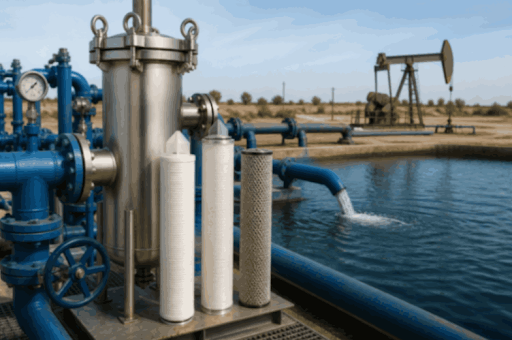
Filter Concept’s engineered solution for PWRI service is a duplex Cartridge Filter Housing arrangement in Super Duplex 2507, installed downstream of the deoiling hydrocyclone or flotation unit and upstream of the HP injection pump suction. The two-stage cartridge configuration is selected based on the actual produced water analysis — not from a generic catalogue.
Stage 1 — Oil Adsorbing Filter Cartridges. Engineered fibre media with high affinity for dispersed and emulsified oil droplets, capturing residual oil to below 10 mg/L. This is the stage that protects formation permeability and stops near-wellbore plugging. For fields with rising water-cut, the oil-adsorbing grade can be upgraded over time without replacing the housing — a critical lifecycle advantage that lower-spec systems cannot offer.
Stage 2 — Polypropylene Pleated or SS Wire Mesh Cartridge. Mechanical polishing at 2 to
5 micron absolute removes formation sand, scale particles, iron sulphide, and bacterial biomass. The choice between PP pleated and SS wire mesh depends on temperature, chemical compatibility, and whether the system is on FaaS (consumable) or designed for backwashable service.
Super Duplex 2507 housing. Rated for full PWRI injection pressure up to 350 bar. Wetted parts compliant with NACE MR0175 / ISO 15156 sour service requirements. Pitting resistance equivalent (PREN) above 40 — the engineered threshold for high-chloride produced water service. Optional 3.1 / 3.2 material certification under EN 10204 for European jurisdictions.
Duplex arrangement with online changeover. Two housings in parallel with a pressure-rated swing-check or auto-changeover valve manifold. Element changeout happens on the offline housing while the online housing carries full flow. Zero process interruption — critical for offshore platforms where injection downtime cascades immediately into production deferment, and equally critical for onshore operations under contractual reservoir maintenance obligations.
FC-PDS™ specification methodology. Cartridge type, micron rating, and changeout frequency are not chosen from a price list. They are specified from your actual weekly produced water analysis: oil-in-water (mg/L), TSS (mg/L), particle size distribution (D50, D90), iron content, sulphide content, and water-cut trajectory. As the field matures and water cuts increase, the cartridge specification is upgraded under FCPL’s FaaS model without housing replacement.
Engineering Specifications at a Glance
| Parameter | Specification |
| Housing Material | Super Duplex 2507 (UNS S32750) — chloride and sour-service rated |
| Filter Media (Stage 1) | Oil Adsorbing Filter Cartridge — 5–10 micron |
| Filter Media (Stage 2) | PP Pleated or SS Wire Mesh Cartridge — 2–5 micron |
| Operating Pressure | Up to 350 bar (PWRI HP injection rated) |
| Flow Rate | 100–2,000 ms/hr per housing (multi-housing skids available) |
| Oil-in-Water Outlet | Less than 10 mg/L (PWRI formation-grade) |
| Solids Outlet | Less than 10 ppm @ 2 micron |
| Service Compatibility | Produced water with H₂S, CO₂, dissolved scale, residual oil |
| Sour Service Compliance | NACE MR0175 / ISO 15156 |
| Hazardous Area Rating | ATEX Zone 1/2 / IECEx (offshore-grade) |
| Parameter | Specification |
| Element Changeout | Duplex housing arrangement — online changeover, no shutdown |
| Service Model | FaaS + Retrofit (cartridge spec upgrades as water-cut increases) |
Operational and Commercial Outcomes
Properly specified PWRI filtration produces measurable results inside the first six months of operation, and compounding savings over the asset life. The most consistent outcomes across FCPL’s installed base in onshore and offshore upstream operations globally are:
- HP injection pump overhaul intervals restored from 8–12 months back to design 30–36 months — typically 2–3 fewer pump interventions per year per train.
- Acid stimulation frequency reduced from every 18 months to every 4–6 years per well — USD 80,000–150,000 onshore (and multiples of that offshore) saved per avoided event.
- Injectivity index sustained within 5% of reservoir engineering forecast across the asset lifecycle, protecting pressure maintenance and EOR program economics.
- Produced water disposal compliance margins improved — outlet oil-in-water consistently below MARPOL 30 mg/L offshore and below regional onshore disposal thresholds.
- Mechanical seal life on HP pumps extended — reducing offshore lift mobilisations and onshore desert workover frequency.
For a 50,000 BWPD water injection system, the combined savings from pump life extension, stimulation avoidance, and sustained injectivity typically fall in the USD 1.5 to 4 million annual range — against a filtration investment that recovers in less than nine months. Move that arithmetic to a 200,000+ BWPD offshore PWRI system and the savings scale linearly.
Global Standards & Regional Compliance Matrix
PWRI filtration crosses three regulatory domains: pressure equipment safety, sour service material compliance, and environmental discharge permitting. The FCPL Cartridge Filter Housing for PWRI service is engineered to international baselines, with regional certifications added per destination market:
| Region / Cluster | Applicable Standards & Regulations |
| International (Universal) | API RP 19B / API 14E (produced water systems) · NACE MR0175 / ISO 15156 (sour service) · ASME Section VIII Div. 1 (pressure vessels) · ATEX 2014/34/EU · IECEx Zone 1/2 · ISO 14001 environmental management |
| Region / Cluster | Applicable Standards & Regulations |
| North America (Onshore) | EPA Class II UIC injection well permits · SDWA Underground Injection Control · Texas Railroad Commission rules · Alberta AER Directive 051 · OSHA PSM compliance |
| North America (Offshore) | BSEE 30 CFR 250 · NPDES discharge permits (USEPA) · USCG offshore vessel standards · API RP 14E |
| North Sea & Europe | OSPAR Commission produced water targets · NORSOK S-001 · NORSOK M-001 (materials) · PED 2014/68/EU · UK HSE offshore safety case · SEVESO III |
| Middle East & GCC | Saudi Aramco SAES-A-104 / SAES-G-005 · ADNOC technical specifications · KOC engineering standards · PDO standards · QatarEnergy specs · MARPOL Annex I |
| Africa | NUPRC pipeline & production regulations (Nigeria) · SABS (South Africa) · ANP regulations (Angola) · NEMA environmental standards |
| Asia-Pacific & India | MoEFCC produced water norms · CPCB Class A discharge standards · NGT OM 2023 (produced water reuse) · OISD-179 (onshore facilities) · PESO pressure vessel rules · PETRONAS / PTT engineering specs |
| Latin America | Petrobras N-2624 · ANP Resolution 17/2015 (offshore Brazil) · Pemex NRF specifications · SERNAGEOMIN (Chile) |
Compliance is rarely the trigger for the procurement conversation — reservoir performance and pump reliability usually are — but compliance becomes decisive at supplier qualification stage. A filtration specification that satisfies EPA UIC permits in Texas, ADNOC SAES standards in Abu Dhabi, OSPAR commitments in the North Sea, and OISD-179 in India is a specification that closes faster across global procurement teams. That is exactly how FCPL’s Super Duplex 2507 housing range is engineered.
The Bottom Line for Reservoir Engineers, Asset Managers, and BD Teams
PWRI is one of the few process decisions in upstream operations where the right answer pays back inside a single budget year and continues paying back for the life of the asset. The wrong answer is not catastrophic — it is merely expensive, recurring, and slowly demoralising for the production engineering team that has to fight injectivity decline year after year. Both are choices made at the filtration specification stage.
Filter Concept has been engineering PWRI filtration solutions for the global upstream sector for over twenty-three years, with installations across onshore production fields, offshore platforms, FPSO topsides, and central processing facilities in 90+ countries. Customers
include national oil companies, international majors, FPSO operators, and EPC contractors building greenfield PWRI plants from the Brazilian pre-salt to the Cambay Basin. The Cartridge Filter Housing in Super Duplex 2507 is one of our most engineered, most repeated, and most defensible installations — because the chemistry of produced water is universally aggressive, but the discipline of engineering against it correctly is not universally applied.
If your injectivity index is trending downward, if your HP injection pump overhaul interval has slipped below design, or if your last reservoir review flagged near-wellbore damage as a recovery risk — your PWRI filtration is the first place to look. We are happy to review your produced water analysis and offer a specification at no obligation, anywhere in the world.
ABOUT THE AUTHOR
Mehul J Panchal is the Founder of Filter Concept Group, a global industrial filtration manufacturer serving 5,000+ customers across 90+ countries with 23+ years of engineering depth. The company’s product portfolio spans 50+ industries including oil & gas, LNG, petrochemicals, power, water treatment, pharmaceuticals, and food processing. Mehul writes on filtration economics, process engineering, and the practical realities of running filtration systems at industrial scale.