

By Mehul J Panchal, Founder, Filter Concept Group | 8-minute read | Oil & Gas Filtration Series
Every gas processing plant and refinery operating an amine treating unit — from the
The U.S. Gulf Coast to the Arabian Peninsula, from West Africa to Southeast Asia — is quietly losing money to a problem most BD presentations never quantify: heat-stable amine salts. The amine itself does not fail. The carbon steel piping does not fail overnight. What fails, slowly and expensively, is the economics of the unit — amine make-up costs creep up, reboiler duty climbs, absorber packing fouls, and one day the H₂S specification at the pipeline tie-in starts drifting. By the time the plant chemist calls a meeting, the contamination has been building for 18 months.
The fix is not exotic. It is not a new amine formulation, a different absorber column, or a software upgrade. It is a properly engineered slipstream cartridge filter on the lean amine circulation loop — sized, specified, and serviced for the actual chemistry of your unit. This
The article explains exactly how that filter works, why generic filtration fails on amine service, and what every operator running a sweetening unit should be specifying today — regardless of geography.
The Hidden Cost: What Heat-Stable Amine Salts Actually Do to Your Unit
Amine treating units — whether running MEA, DEA, MDEA, or DGA — absorb H₂S and CO₂ from natural gas, refinery off-gas, and petrochemical streams. The chemistry is well understood. The failure mode of the chemistry, however, is rarely engineered for at the design stage.
Through thermal cycling and oxidative exposure, every amine system gradually forms heat-stable amine salts (HSAS). These are non-regenerable degradation products — organic acids that bind permanently with the amine and remove it from active duty. A reclaimer can pull liquid-phase degradation products out of the system, but it cannot remove the solid and semi-solid particulates that form alongside HSAS: iron sulphide scale shed from carbon steel piping, iron oxide from corroded heat exchangers, and polymerised amine fragments.
The numbers tell the story. In a typical 100+ MMSCFD amine treating unit, uncontrolled HSAS accumulation drives amine make-up consumption from a design rate of 0.1 kg/MMSCF to 0.5–1.0 kg/MMSCF within two years. At current MDEA pricing, that single line item alone represents an annual leak of USD 200,000 to 500,000 — and that figure scales linearly with throughput. A 500 MMSCFD LNG feed gas treater, common in Qatar, Australia, and the U.S. Gulf, can lose USD 1–2.5 million annually to nothing more than untreated HSAS.
And that is before you count the secondary damage: overhead condenser fouling, accelerated corrosion of carbon steel piping from organic acid attack, increased reboiler steam consumption (typically 20–30% above design), absorber packing maldistribution, and the most expensive consequence of all — unplanned shutdowns when the H₂S specification at the fuel gas tie-in or LNG feed drifts above pipeline or contractual limits.
Why Generic Filtration Fails on Amine Service
Most plants we audit have something on their amine loop. A bag filter. A basket strainer. Sometimes a single-stage cartridge housing was installed during the original FEED. None of these are wrong by themselves. They are wrong as a system for amine service, for three specific reasons:
- Material incompatibility. Carbon steel housings on amine service contribute iron to the very system you are trying to protect from iron sulphide. Within months, the housing itself becomes a contamination source. SS 316L is the only acceptable wetted material for serious amine service — anything less is a false economy, and NACE MR0175 / ISO 15156 sour service compliance demands it.
- Single-stage logic on a two-stage problem. HSAS is dissolved degradation chemistry. Iron sulphide and polymer fragments are physical particulates. A single mechanical filter — no matter how fine — cannot remove dissolved heat-stable salts. You need adsorption (activated carbon) AND mechanical filtration (pleated cartridge) working in series. Most plants have only the second stage and wonder why amine quality keeps degrading.
- Wrong placement. Putting a filter on the main amine circulation line forces a compromise: either the filter is oversized and expensive, or it is undersized and creates a permanent pressure-drop penalty on the entire absorber feed. The correct engineering answer is a slipstream — 5 to 10 percent of total circulation — polished continuously, with zero impact on main loop pressure drop.
Once these three failures are corrected together, the economics of an amine unit shift dramatically. The filtration system stops being a maintenance line item and becomes a profitability lever — and one that pays back inside twelve months at current solvent and energy prices anywhere in the world.
The FCPL Solution: Cartridge Filter Housing on Slipstream Service
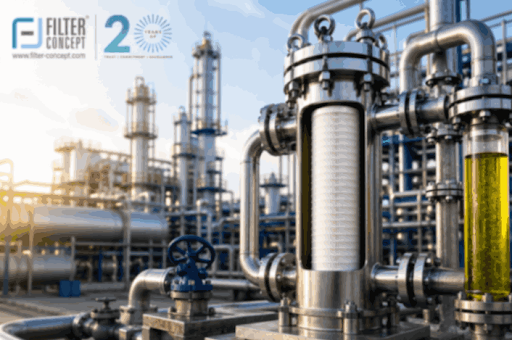
Filter Concept’s engineered solution for amine treating units is a dedicated SS 316L Cartridge Filter Housing assembly installed on a slipstream loop, with a two-stage media configuration designed specifically for the chemistry of degraded amine.
Stage 1 — Activated Carbon Adsorption. An activated carbon cartridge removes heat-stable salts, organic acid degradation products, and dissolved hydrocarbons that would otherwise foul the absorber and contaminate the regenerator overhead. This is the stage almost every operator we audit is missing today — the silent gap between FEED-stage filtration design and real-world amine chemistry.
Stage 2 — Polypropylene Pleated Cartridge at 5 micron absolute. The polishing stage captures iron sulphide particles, iron oxide scale, and polymerised amine fragments before they reach the absorber column packing or the lean/rich heat exchanger tubes. Five-micron absolute rating is the engineered sweet spot — fine enough to protect column internals, coarse enough to give realistic element life on a contaminated system.
Slipstream Configuration. The housing is installed on a 5–10 percent slipstream off the lean amine circulation header, downstream of the regenerator and upstream of the absorber inlet. This placement gives continuous polishing without any pressure drop impact on the main process loop, and allows element change-out without unit shutdown — a critical advantage in 24/7 LNG and refinery operations.
FaaS — Filtration-as-a-Service. Rather than selling housings and walking away, FCPL offers the entire installation as a managed service across our global service footprint. Quarterly amine analysis triggers element change-out. Inlet and outlet HSAS measurement is included in the service report. The plant gets guaranteed amine quality; FCPL manages the
consumables, the logistics, and the documentation — with regional service teams operating across the GCC, India, Southeast Asia, Africa, and select Western markets.
Engineering Specifications at a Glance
| Parameter | Specification |
| Housing Material | SS 316L (amine-compatible, no iron contribution) |
| Filter Media (Stage 1) | Activated Carbon Adsorber Cartridge |
| Filter Media (Stage 2) | Polypropylene Pleated Cartridge — 5 micron absolute |
| Slipstream Flow Rate | 5–10% of total amine circulation (typically 50–500 ms/hr) |
| Operating Pressure | Up to 10 bar |
| Operating Temperature | 40–80°C lean amine service |
| Amine Compatibility | MEA, DEA, MDEA, DGA |
| HSAS Removal Efficiency | Greater than 90% |
| Pressure Vessel Code | ASME Section VIII Div. 1 / PED 2014/68/EU compatible |
| Hazardous Area Rating | ATEX Zone 1 / IECEx (H₂S environment compatible) |
| Sour Service Compliance | NACE MR0175 / ISO 15156 |
| Service Model | FaaS (Filtration-as-a-Service) with quarterly element review |
Operational and Commercial Outcomes
When the slipstream Cartridge Filter Housing is correctly engineered and serviced, plants typically see measurable returns within the first quarter of operation. The most consistent outcomes across FCPL’s installed base in gas processing and refining — across geographies— are:
- CO₂ absorption efficiency improvement of 10–15% due to cleaner lean amine returning to the absorber.
- Amine make-up consumption reduction of 60–80% as HSAS-driven amine loss is arrested.
- Reboiler steam duty reduction of 15–25% as iron sulphide scale on tubes is prevented from forming.
• Maintenance interval extension on absorber packing and lean/rich exchangers,
translating into one fewer scheduled outage every 18–24 months.
- H₂S specification compliance at the fuel gas or LNG feed tie-in becomes consistent rather than reactive — critical for pipeline operators, LNG offtakers, and statutory inspectors alike.
For a 100 MMSCFD unit, the combined annual saving from amine make-up reduction and reboiler duty optimization alone typically falls in the USD 200,000 to 400,000 range. For a 500 MMSCFD LNG feed treater, savings scale to USD 1–2 million annually. The filtration capital investment recovers in well under twelve months — and on FaaS, the model becomes purely operational expenditure with no capex hurdle at all.
Global Standards & Regional Compliance Matrix
Amine service filtration sits at the intersection of pressure equipment safety, sour service materials compliance, and hazardous area certification. The FCPL Cartridge Filter Housing for amine service is engineered to comply with international standards as the baseline, and is supplied with regional certifications appropriate to the destination market. Operators in any of the regions below receive housings configured for their local statutory framework:
| Region / Cluster | Applicable Standards & Regulations |
| International (Universal) | ASME Section VIII Div. 1 (pressure vessel) · API 945 (avoiding amine cracking) · NACE MR0175 / ISO 15156 (sour service materials) · ISO 8573-1 (compressed air purity) · ATEX / IECEx Zone 1 |
| North America | ASME BPVC · API RP 945 · API 614 · OSHA PSM 29 CFR 1910.119 · EPA Air Quality compliance · DOT pipeline regulations |
| Europe | PED 2014/68/EU (Pressure Equipment Directive) · EN 13445 · ATEX Directive 2014/34/EU · SEVESO III · EN 10204- 3.1/3.2 material certification |
| Middle East & GCC | ADNOC / Saudi Aramco engineering standards · QatarEnergy specifications · KOC standards · SASO certification · GSO conformity |
| Africa | SONCAP (Nigeria) · SABS (South Africa) · KEBS (Kenya) · EAC mark · NUPRC pipeline compliance |
| Asia-Pacific & India | OISD-118 (India — amine unit inspection) · PNGRB Pipeline Regulations · IS 2825 / IS 15958 · PESO certification · PTT / PETRONAS engineering specs (SE Asia) |
| Latin America | Petrobras N-2624 · Pemex NRF specifications · INMETRO compliance (Brazil) |
This is not a checkbox exercise. When inspection regimes — whether OSHA PSM in the United States, OISD-118 in India, ADNOC technical audits in the UAE, or PED in Europe —
flag amine system degradation, the first remediation question is invariably: “What is on the slipstream?” Plants with a properly specified Cartridge Filter Housing answer that question in one line. Plants without one inherit a multi-month corrective action plan.
The Bottom Line for Plant Heads and Process Engineers
Amine filtration is one of the small number of process decisions where the right answer is technically simple, commercially obvious, and yet routinely deferred for years at plants worldwide. The cost of inaction is not dramatic — it is gradual, masked by amine make-up budgets that grow quietly and reboiler duty that creeps upward year on year. Which is exactly why it deserves attention now, before the next regulatory inspection or the next contractual H₂S excursion forces the conversation.
Filter Concept has been engineering filtration solutions for the global oil and gas sector for over twenty-three years, with installations across refineries, gas processing plants, LNG facilities, and petrochemical complexes in 90+ countries. Our customer base spans national oil companies, international majors, EPC contractors, and independent operators — from the Permian and Eagle Ford to the North Sea, from Ras Laffan and Yanbu to Bonny Island, from Gladstone to Hazira. The Cartridge Filter Housing for amine service is one of our most engineered, most repeated, and most measurable installations — because the chemistry of amine degradation is universal, but the discipline of solving it correctly is not.
If your amine make-up consumption has been climbing, if your reboiler steam duty is above design, or if your last unit inspection raised questions about amine system integrity — your slipstream filtration is the first place to look. We are happy to review your unit’s lean amine analysis and offer a specification at no obligation, anywhere in the world.
ABOUT THE AUTHOR
Mehul J Panchal is the Founder of Filter Concept Group, a global industrial filtration manufacturer serving 5,000+ customers across 90+ countries with 23+ years of engineering depth. The company’s product portfolio spans 50+ industries including oil & gas, LNG, petrochemicals, power, water treatment, pharmaceuticals, and food processing. Mehul writes on filtration economics, process engineering, and the practical realities of running filtration systems at industrial scale.